
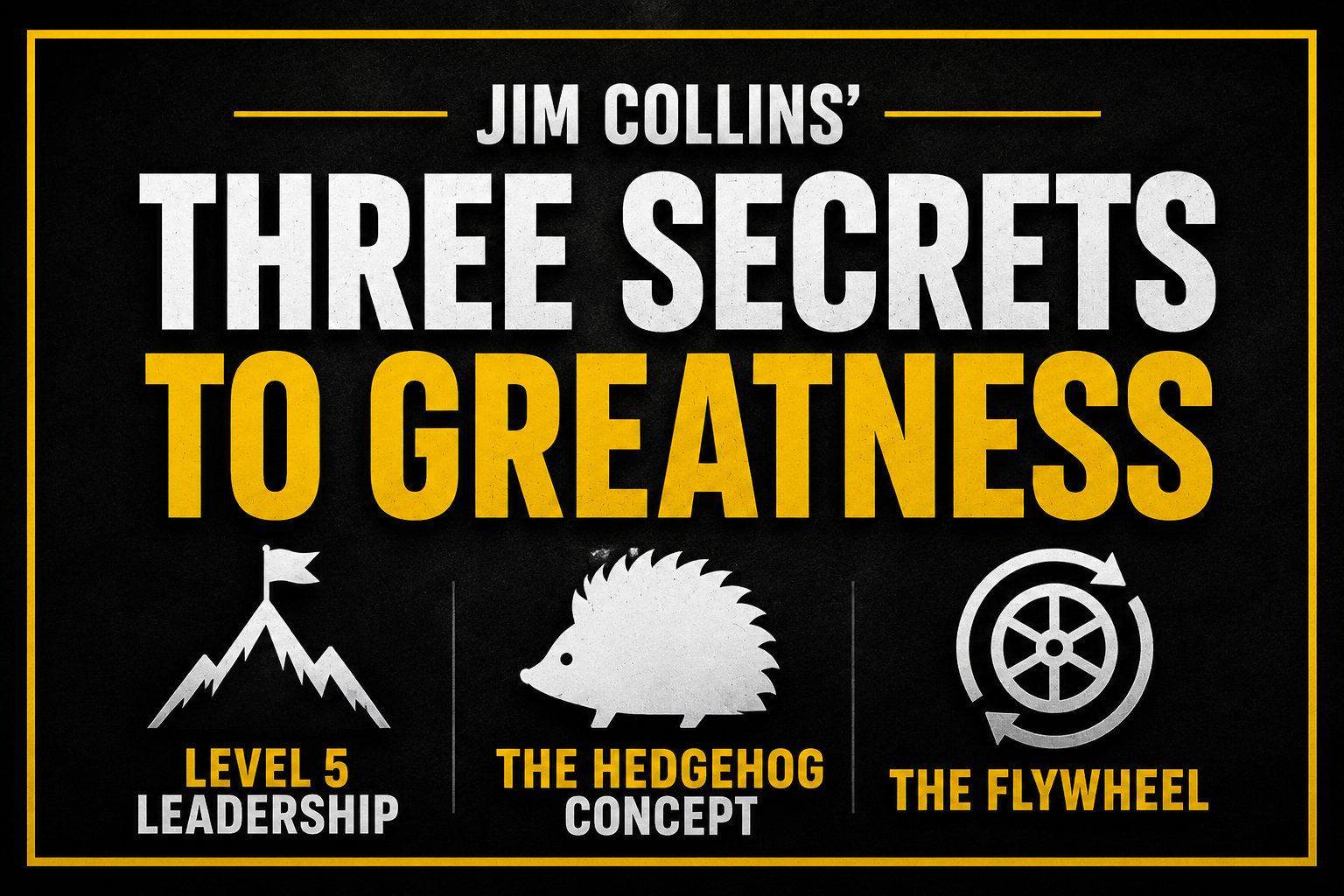
Jim Collins studied why some companies become truly great while others stay merely good, and his findings are counterintuitive. For contractors, it comes down to three things: Level 5 leadership, which pairs deep humility with fierce professional will; the Hedgehog Concept, relentless focus on the one thing you can be the best at that also makes real money; and the flywheel, the truth that greatness comes from consistently pushing in one direction until momentum compounds, not from one dramatic move.
That’s the whole thing. Let me open it up, because the difference between the contractors who break through and the ones stuck at the same level for years is exactly what Collins uncovered.
Good Is the Enemy of Great
Jim Collins opened his research with a line that should stop every contractor cold: good is the enemy of great. And once you understand what he meant, you’ll see it everywhere in this industry.
Here’s the idea. The reason most companies never become great isn’t that greatness is impossible. It’s that they became good, and good was comfortable enough to stop pushing. Good pays the bills. Good keeps the lights on. Good lets you take a breath. And because good is comfortable, most businesses settle right there and never climb higher. Good becomes the ceiling, not because they couldn’t go further, but because they stopped trying once things were okay. The very okayness of “good” is what kills the drive to become great.
Look around the trades and you’ll see it. Tons of good contractors. Solid businesses, decent revenue, fine reputations, running along at the same level year after year after year. They’re not failing, which is exactly the problem, because failing would force a change. They’re comfortable, so they coast, and they stay good forever. Meanwhile a small number of contractors in the same markets, with the same opportunities, break through and become genuinely great, growing, dominating, building something remarkable. What separates them?
That’s the whole question Collins set out to answer, and his findings are the roadmap. The first and most important truth is this: becoming great starts with refusing to settle for good. You have to decide that good isn’t good enough, that you’re not going to coast at okay, that you want to build something great. Without that decision, none of the rest matters, because you’ll stop pushing the moment things get comfortable. With it, the rest of the framework shows you how. Let me walk you through the three pieces that matter most for a contractor.
Level 5 Leadership: Humble and Driven at the Same Time
Collins’ first big counterintuitive finding was about the leaders of great companies, and it’s the opposite of what most people expect. The leaders who took companies from good to great weren’t the loud, larger-than-life, ego-driven celebrity types. They were something Collins called Level 5 leaders, and they shared a strange combination: deep personal humility paired with intense professional will.
Sit with that combination, because it’s the key. On one side, deep humility. These leaders weren’t in it for their own glory. They were quiet, modest, more interested in the success of the company than in personal credit. On the other side, intense professional will. They were fiercely, relentlessly determined to make the company great. Not soft, not passive, ferociously driven, but driven for the business rather than for their own ego. Humble about themselves, unstoppable about the mission. Most people assume you have to pick one, that you’re either the humble nice guy or the driven hard-charger. The great leaders were both at once, and that combination is what set them apart.
Collins described how these leaders handled credit and blame with a simple picture: the window and the mirror. When things go well, the Level 5 leader looks out the window and gives the credit to others, to the team, to good fortune, to everyone but themselves. When things go badly, they look in the mirror and take the responsibility themselves, no blaming the team, the market, or bad luck. Window for credit, mirror for blame. That’s the exact opposite of the ego-driven leader who grabs the credit and points the finger, and it’s the same blame-up-credit-down principle I wrote about with the Buffett approach. It’s not a coincidence that the same trait keeps showing up in great leaders.
For you as an owner-operator, this is a direct challenge. Building a great business requires checking your ego. It means being ambitious for the business, not for your own glory. It means giving your people the credit when things go right and taking the responsibility yourself when things go wrong. It means having the humility to build something bigger than yourself, and the fierce will to actually make it happen. Most contractors have plenty of will, they’re hard workers by nature. The humility, the window-and-mirror discipline, the ego-check, is often the harder half. Master both, and you lead like the people who built great companies.
Collins found one more thing about these leaders worth knowing: they got the right people before they figured out the exact plan. He called it first who, then what. The great companies made sure they had the right people on the team, and moved the wrong people off, before they locked in their strategy, because they understood that a great business is built by great people, and no brilliant plan survives the wrong team executing it. For a contractor, this means your hiring and your team decisions matter more than your clever strategy. Get the right people in the right seats, hold them to a real standard, and part with the ones who don’t fit, and you’ve built the foundation that everything else stands on. Great business, great people, in that order.
The Hedgehog Concept: Do One Big Thing, Not Everything
Collins’ second key concept came from an old idea that the fox knows many things, but the hedgehog knows one big thing. The fox is clever and scattered, chasing everything. The hedgehog does one thing supremely well. And great companies, Collins found, are hedgehogs. They found their one big thing and focused on it relentlessly, while the merely good companies stayed scattered foxes.
The Hedgehog Concept is the intersection of three circles, and greatness lives right where all three overlap. The first circle: what can you be the best at? Not just good at, genuinely the best, better than anyone else in your market. The second circle: what are you deeply passionate about? What do you actually care about and want to build? The third circle: what drives your economic engine? What actually makes you real money? Where those three circles overlap, the thing you can be the best at, that you’re passionate about, that also makes money, that’s your hedgehog, and focusing relentlessly on it is a huge part of what makes a company great.
Here’s how this nails most contractors. Most are foxes, scattered. They try to be everything to everyone, offer every service, chase every kind of job, serve every customer, spread thin across a dozen things they’re merely okay at. And being okay at many things is exactly what keeps them merely good. The great contractors are hedgehogs. They found the specific thing they can genuinely be the best at, that they care about, that makes real money, and they focused relentlessly on it, becoming exceptional at that instead of mediocre at everything. This connects to the whole idea of positioning and focus, being known for something specific and being the best at it beats being a jack-of-all-trades, and it connects to the capacity trap, where chasing every job keeps you from the high-value work you should own.
So find your hedgehog. Honestly answer the three questions. What can you truly be the best at in your market? What are you passionate about building? What actually drives your profit? Find the overlap and pour your focus there, and have the discipline to say no to the scattered fox work that pulls you away from it. Focus is a decision, and it’s one of the biggest decisions on the path from good to great.
The Flywheel: Why Greatness Has No Silver Bullet
Collins’ third concept is the one I want you to tattoo on your brain, because it’s the truth behind everything I’ve written all year. He called it the flywheel, and it explains why some businesses build unstoppable momentum while others stay stuck at the same level forever.
Picture a massive, heavy flywheel, a giant metal disc that’s incredibly hard to move. You push it, and at first almost nothing happens. It barely budges. You push again, and it moves a little. You keep pushing, turn after turn, and it starts to go a bit faster. And you keep pushing, consistently, in the same direction, and slowly the momentum builds. Then a bit more. And at some point, all that accumulated effort compounds, and the flywheel is spinning with tremendous, unstoppable momentum, almost turning itself. But here’s the crucial part: there was no single push that did it. No one magic turn made the difference. It was the cumulative effect of consistent pushing, in one direction, over a long time. Greatness came from the sum of all the pushes, not from any single dramatic move.
That’s how great companies actually get built, and it’s the opposite of what most people believe. Most contractors stuck at the same level are looking for the silver bullet, the one big move, the magic marketing tactic, the lucky break, the single thing that will transform everything overnight. And they keep not finding it, because it doesn’t exist. Worse, they often push the flywheel a few turns in one direction, get impatient when it doesn’t instantly take off, and switch directions, and switch again, so they never build momentum at all. That’s the doom loop, and it’s where a lot of good-but-not-great businesses live forever, always starting over, never compounding.
The great contractors understand the flywheel. They pick a direction, their hedgehog, and they push consistently, turn after turn, month after month, without expecting an overnight miracle and without switching directions every time they get impatient. And that consistency, that relentless pushing in one direction, is what eventually builds the unstoppable momentum that separates them from everyone else.
Now, if you’ve been reading my stuff all year, this should sound deeply familiar, because the flywheel is the exact same truth as the snowball I keep describing, and the gym, and the reps, and the consistency that compounds. It’s the intellectual foundation under everything. Momentum comes not from one big thing but from small consistent pushes in one direction, sustained long enough to compound. The flywheel is Collins’ name for it. The snowball is mine. They’re the same law. And understanding it is what lets you stop chasing silver bullets and start doing the patient, consistent work that actually builds greatness.
Putting It Together
So there’s the good-to-great path for a contractor, and the three pieces fit together into one coherent way of building a great business.
You lead the right way, with Level 5 leadership, deep humility paired with fierce will, ego in check, credit out the window and blame in the mirror, ambitious for the business rather than yourself. You focus on the right thing, your Hedgehog Concept, the intersection of what you can be the best at, what you’re passionate about, and what drives your profit, with the discipline to say no to everything else. And you do it the right way, by pushing the flywheel, consistent effort in one direction, sustained over time until the momentum compounds into something unstoppable, instead of chasing silver bullets or switching directions every few months.
Lead right, focus right, push relentlessly. Underneath all three is the same starting decision: refusing to settle for good. Because good is comfortable, and comfortable is where greatness goes to die. The contractors who break through and become genuinely great aren’t luckier or more talented than the ones who stay stuck. They decided good wasn’t good enough, they led with humility and will, they focused on their hedgehog, and they pushed the flywheel patiently until it took off. Every bit of that is a choice available to you.
How to Roll This Out Starting Monday
Same rhythm as always. One piece at a time, built to last.
Week one: make the decision and check your ego. Decide, honestly, that good isn’t good enough and you’re building something great. Then work on the Level 5 leadership, practice the window and mirror, giving your team credit and taking the blame yourself, and lead with humility paired with fierce will. Greatness starts with the decision and the leadership.
Week two: find your hedgehog. Honestly answer the three questions. What can you genuinely be the best at in your market? What are you passionate about building? What actually drives your profit? Find where they overlap, and identify the scattered fox work you need the discipline to say no to.
Week three: pick your direction and start pushing the flywheel. Commit to your hedgehog as the direction you’ll push consistently, and stop chasing silver bullets and switching directions. Start the patient, consistent pushing that builds momentum, understanding that the early turns feel slow and that’s normal.
Week four: build the discipline to keep pushing. Set up the consistency and accountability that keep you pushing the flywheel in one direction over the long haul, even when it’s slow, even when it’s tempting to chase the next shiny thing. The whole payoff is in sustaining the push long enough to compound.
Four weeks to start down the path, and years of consistent flywheel-pushing to arrive at greatness. But the direction is clear, and every step is a choice you get to make.
Frequently Asked Questions
What does “good is the enemy of great” mean for contractors? It means most contractors never become great because they became good, and good is comfortable enough to stop pushing. Good pays the bills and keeps things okay, so businesses settle there for years. Failing would force change, but merely being good invites coasting. Becoming great starts with refusing to settle, deciding that okay isn’t good enough and committing to build something more.
What is Level 5 leadership and how does it apply to owners? It’s the counterintuitive combination Jim Collins found in great-company leaders: deep personal humility paired with intense professional will. They’re ambitious for the business, not their own ego, giving credit to others (looking out the window) and taking blame themselves (looking in the mirror). For an owner-operator, it means checking your ego, building something bigger than yourself, and pairing humility with fierce determination.
What is the Hedgehog Concept for a home service business? It’s the intersection of three things: what you can genuinely be the best at, what you’re passionate about, and what actually drives your profit. Great companies find that overlap and focus relentlessly on it, while merely good ones stay scattered, trying to be everything to everyone and staying mediocre at many things. Finding your hedgehog and having the discipline to say no to everything else is central to greatness.
What is the flywheel effect? It’s the idea that greatness comes not from one dramatic move but from consistently pushing in one direction, turn after turn, until momentum compounds into something unstoppable. There’s no single magic push. Contractors stuck at the same level chase silver bullets or keep switching directions, so they never build momentum. The great ones pick a direction and push patiently until the accumulated effort takes off.
Why do some contractors stay stuck at the same level for years? Usually because they settle for good, chase silver bullets instead of pushing a consistent flywheel, or stay scattered foxes instead of focusing on a hedgehog. They keep looking for one magic move, get impatient, and switch directions before momentum can build, which Collins called the doom loop. Greatness requires refusing to settle, focusing relentlessly, and pushing consistently in one direction over time.
The Bottom Line
Jim Collins studied why some companies become great while others stay merely good, and the lessons map straight onto the trades. Good is the enemy of great, because good is comfortable and comfortable is where the drive to improve quietly dies. The contractors stuck at the same level for years aren’t failing, they’re just settling, and settling feels fine right up until you realize a decade went by at the same spot.
Breaking through takes three things. Lead with Level 5 leadership, humble about yourself and fiercely driven for the business, credit out the window and blame in the mirror. Find your Hedgehog Concept, the one thing you can be the best at that you love and that makes money, and focus on it relentlessly. And push the flywheel, consistent effort in one direction, patient through the slow early turns, until the momentum compounds into something unstoppable.
There’s no silver bullet, there never was. There’s just the decision to refuse to settle, and the discipline to lead right, focus right, and push relentlessly. That’s the whole path from good to great, and every step of it is a choice sitting right in front of you.
If you want help making the leap from a good contractor business to a genuinely great one, that’s exactly the work we do with contractors every day. Book a free strategy session and let’s build something great.
Josh Kelly is Co-Founder of Clover Growth Partners, where he helps home service contractors build businesses that grow without depending on them being in every truck.