
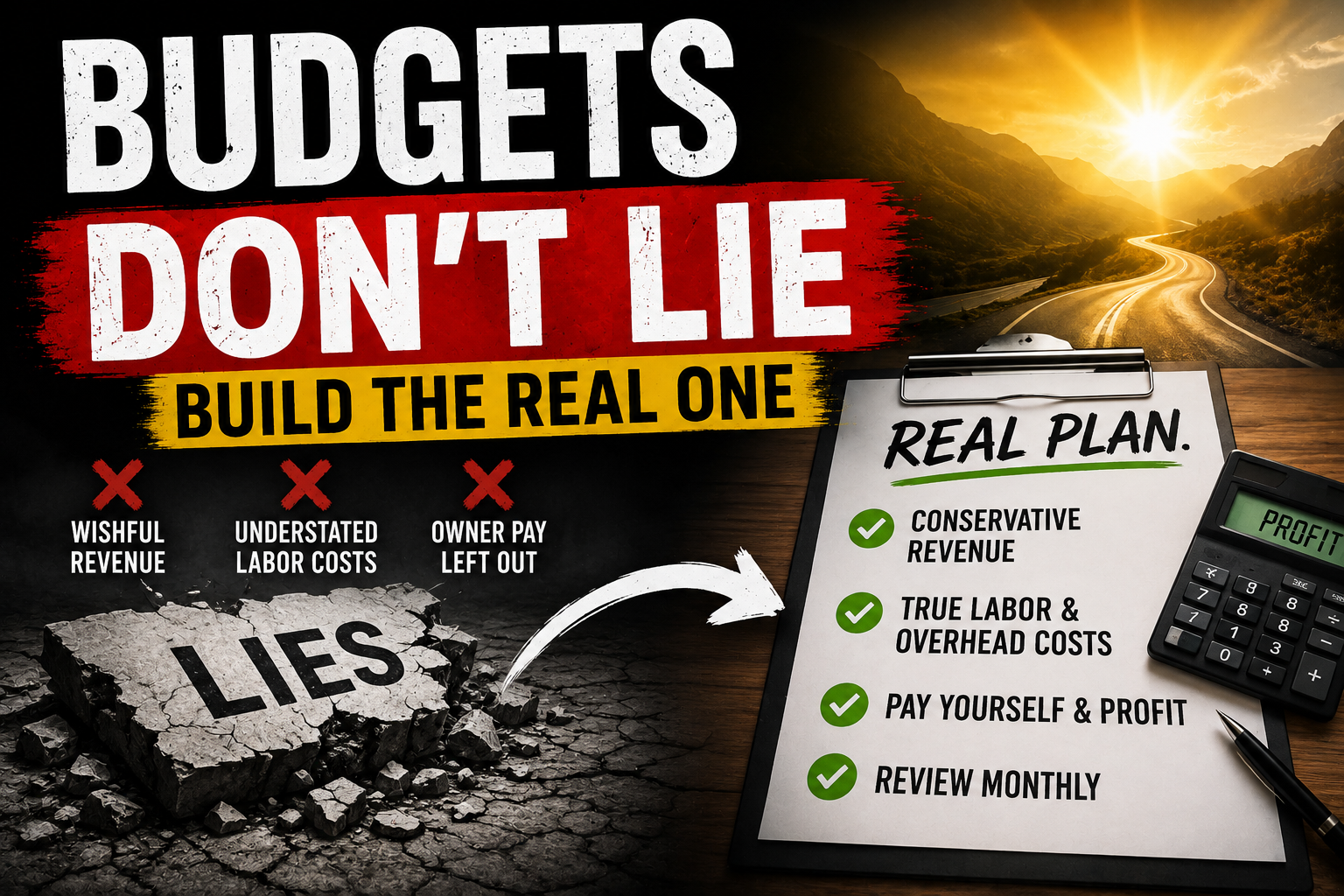
Most contractor budgets are wrong before the year even begins, because they’re built on three lies: wishful revenue numbers, understated labor costs, and owner pay that got left out entirely. A budget built on hope isn’t a plan, it’s a fantasy that falls apart the second reality hits. Build a real one by forecasting revenue conservatively from actual data, using the true fully loaded cost of labor and overhead, paying yourself a real salary plus profit, and reviewing it against actuals every month.
That’s the whole thing. Let me open it up, because a budget that lies to you is more dangerous than no budget at all.
Why Most Contractor Budgets Are Fantasy
Let’s start with the uncomfortable truth about how most contractors handle budgeting, because you can’t fix a problem you won’t look at.
Most contractors fall into one of two camps. The first camp doesn’t budget at all. They just run the business by the bank balance, hoping there’s enough at the end of the month, flying completely blind. The second camp does build a budget, but it’s basically a wish list dressed up in numbers. They plug in the revenue they hope to hit. They understate the costs because the real numbers are uncomfortable. They forget half their actual overhead. And they don’t pay themselves properly, if at all. The result looks great on the spreadsheet, nice big revenue, healthy-looking profit, and it has almost nothing to do with reality.
Here’s why that second camp is actually the more dangerous one. A budget built on wishful thinking doesn’t just fail to help you, it actively hurts you, because it gives you false confidence. You look at your beautiful fantasy budget and you feel good, you feel like you’ve got a plan, so you make decisions based on it. You spend, you hire, you commit, all based on numbers that were never real. And then reality shows up, the revenue’s lower than you hoped and the costs are higher than you pretended, and the whole thing collapses, usually right when you can least afford it.
Think of it like a GPS that lies to you. No GPS at all is bad, you’re driving blind. But a GPS that confidently tells you to turn left when left is a cliff is worse, because you trust it right up until you drive off the edge. A fantasy budget is that lying GPS. It points you confidently in the wrong direction and you follow it because you trust it, until you run out of road. The only budget worth having is a brutally honest one, a real map of reality. So let me show you how to build one, starting with the three lies you have to stop telling.
Lie Number One: Wishful Revenue
The first lie in most contractor budgets is the revenue number, and it’s the foundation the whole fantasy is built on.
Here’s how it happens. You sit down to budget, and when you get to the revenue line, you put in the number you want to hit. The growth you’re hoping for. The big year you’re dreaming of. It feels motivating, aspirational, so you build the whole budget on top of that hopeful number. And then every other number in the budget, the costs you can afford, the people you can hire, the investments you can make, is based on revenue that may never actually show up. When the real revenue comes in below the fantasy, everything you built on top of it is suddenly unaffordable, and you’re in trouble.
The fix is to forecast revenue conservatively, from real data, not from hope. Start with your actual historical numbers, what you really did last year and the years before. Account for your real seasonality, the fact that some months are strong and some are lean, instead of assuming an even flow. Be honest and realistic about growth, factor in reasonable growth if you have real reasons to expect it, but don’t build the entire budget on a best-case moonshot. And here’s the mindset that makes this work: it is far better to beat a conservative number than to miss a fantasy one. If you budget conservatively and then exceed it, that’s a great problem, you’ve got extra. If you budget optimistically and fall short, you’ve got a crisis. So forecast the revenue you can realistically count on, build your budget on that solid foundation, and treat anything above it as upside, not as the plan. Hope is not a revenue forecast.
Lie Number Two: Understated Labor Costs
The second lie is in the labor line, and it’s one that even well-meaning contractors get wrong, because the true cost of an employee is a lot higher than most people budget.
Here’s the mistake. When contractors budget labor, they tend to think about the wage. The tech makes twenty-five dollars an hour, so they budget twenty-five dollars an hour. But the wage is nowhere near the real cost of that employee. The true, fully loaded cost of labor includes a whole stack of things on top of the wage: payroll taxes, workers comp, liability insurance tied to that worker, any benefits you provide, paid time off, and, critically, all the non-productive, unbillable time, the training, the drive time, the downtime, the hours you’re paying for that aren’t generating revenue. Add all that up and the real cost of an employee is dramatically higher than their hourly wage, often far higher than owners realize.
If you budget only the wage, your labor costs are badly understated, which means your budget shows way more profit than you’ll actually make, because a huge chunk of your real labor cost is invisible in your numbers. The fix is to budget the fully loaded cost of labor, the wage plus all the taxes, insurance, benefits, and non-productive time, so your numbers reflect what employees actually cost you. When you use the real fully loaded number, your budget suddenly tells the truth about your labor, which is usually your single biggest expense. This one correction alone reveals a lot of contractors’ budgets to be far less profitable than they thought, which is uncomfortable but essential, because you can’t manage a cost you’re pretending is smaller than it is.
Lie Number Three: The Owner Doesn’t Get Paid
The third lie is the biggest one of all, and it’s the one that keeps contractors trapped in a low-paying job they happen to own. Most contractor budgets don’t properly pay the owner.
Here’s what happens. The owner builds the budget and, when it comes to their own pay, they either leave it out entirely or they treat whatever profit is left over at the end as their compensation. In other words, the owner pays everyone else first, all the employees, all the vendors, all the bills, and then takes whatever scraps are left, if any. And they build their budget that way, with themselves as an afterthought instead of a real, planned expense.
This is exactly how contractors end up, as I’ve said before, buying themselves a low-paying job instead of building a real business. Because when you’re the last one paid and you only get the leftovers, you’re not an owner earning a return, you’re a worker getting whatever’s left after everyone else eats. And your budget, by treating you that way, guarantees it.
The fix has two parts, and both matter. First, budget a real, market-rate salary for yourself, for the actual work you do in the business. If you’re running operations, or selling, or managing, you’d have to pay someone to do that if you left, so budget that cost honestly, with yourself as a real, planned expense paid like any other key role. Second, and this is the crucial part, budget a genuine profit on top of your salary. The business should pay you fairly for your work AND generate a profit as a return on the business itself, those are two separate things. Your salary is pay for your labor. Profit is the return on owning the business. You deserve both, and your budget should include both.
Here’s why this matters so much beyond just your paycheck. When you budget your real salary plus a real profit, your budget finally tells you the truth about whether your business actually works. If the business can afford to pay you a fair wage and still turn a profit, great, you’ve got a real business. If it can’t, if the only way the numbers work is by not paying yourself, that is critical information you need to know, and a real budget reveals it while a fantasy budget hides it. A business that can’t afford to pay its owner properly has a serious problem, and you want your budget to surface that problem so you can fix it, not bury it so you keep grinding for scraps. Pay yourself in the budget, both salary and profit, and let the numbers tell you the truth.
The Overhead Categories Everyone Forgets
Beyond the three big lies, budgets go wrong because contractors forget large chunks of their real overhead. The obvious costs get counted, but a surprising amount of real expense hides in categories owners overlook. Here are the ones that most commonly get missed, and leaving any of them out inflates your fantasy profit.
Insurance in all its forms, which is often bigger than owners expect. Software and technology, all those monthly subscriptions that add up. The true total cost of your vehicles, not just fuel, but maintenance, repairs, insurance, and the very real cost of the trucks wearing out and needing replacement. Marketing, which needs to be a real budgeted line, not a random afterthought. Administrative and office costs. Professional fees for your accountant and attorney. Training and development for your team. The ongoing cost of replacing tools and equipment as they wear out. Your taxes, which are real money that has to be planned for. And a reserve or contingency line, because things break and surprises happen, and a budget with no cushion is a budget one bad month away from a crisis.
Walk through your actual bank and card statements for the past year and you’ll find expenses in categories you never put in your budget. Every one of those missing categories is fantasy profit, money your budget says you have that you actually spent. So hunt them all down and put them in. A real budget accounts for all your costs, including the easy-to-forget ones, because the costs you leave out don’t disappear, they just show up later as a nasty surprise.
Model Scenarios, Don’t Bet on One Guess
Here’s a shift that separates a fragile budget from a resilient one. Don’t build one single budget on one single guess about how the year goes. Model a few scenarios, so you’re prepared for whatever actually happens.
The problem with a single-scenario budget is that reality never matches your one guess exactly, and when it doesn’t, you have no plan. So build a few versions. A conservative scenario, where revenue comes in soft, so you know what you’d do and whether you’d survive a slow year. Your expected scenario, your realistic best estimate, which is your main plan. And an optimistic scenario, where things go well, so you know how you’d handle and invest the upside. Modeling these means you’re not caught flat-footed by any of them, because you’ve already thought through each.
The most important one to model honestly is the downside. Ask the hard question before it happens: what if revenue comes in well under plan? At what point do I have a problem, and what would I cut or change? Knowing your break-even, the revenue level where you’re just covering costs, is one of the most valuable numbers in your whole business, because it tells you exactly how much margin for error you have. A good budget answers “what happens if things go sideways” before things go sideways, so you’re never blindsided. Build the scenarios, know your break-even, and you turn your budget from a single fragile guess into a resilient plan for whatever the year throws at you.
A Budget You Never Look At Is Useless
Here’s the last piece, and it’s where most budgets die even when they were built well. A budget is not a document you build in the fall, feel good about, file away, and never look at again. A budget you don’t review is useless, no matter how good it is.
The whole power of a real budget comes from comparing it to what actually happens, regularly, so you catch problems early. So build a review cadence, ideally monthly. Each month, look at your budget versus your actuals. Where did you land against plan on revenue? On each cost category? On profit? This monthly budget-versus-actual review is one of the highest-value financial habits you can build, because it catches problems while they’re small and fixable, instead of letting them silently compound into a crisis you discover months too late.
This is the same catch-it-early principle behind the real-time customer feedback I wrote about, applied to your money. A problem in your numbers caught in month two is a small adjustment. The same problem discovered in month ten is a disaster. So don’t just build the budget, use it, every month, as the living tool it’s meant to be. Compare, spot the variances, understand why, and adjust. That monthly rhythm is what turns your budget from a fantasy document into an early-warning system that keeps your business out of trouble.
Get Help With the Numbers
One honest note before I wrap up. I want you to understand your numbers deeply, because it’s your business and your money, and no one should be flying blind. But I also want to be straight: this is an area where good professional help pays for itself many times over. A sharp accountant, or a fractional CFO who knows the trades, can help you build a budget that’s accurate, catch things you’d miss, and read what the numbers are really telling you.
I’m not an accountant, and none of this is specific tax or accounting advice, it’s the framework for thinking about your budget honestly. The specifics for your business, the tax implications, the exact structure, should involve a qualified professional. The goal isn’t for you to become an accountant. It’s for you to understand your numbers well enough to make good decisions and to know whether the budget in front of you is honest or fantasy. Understand it yourself, and get expert help to build it right. Both.
How to Roll This Out This Fall
Since this pairs with the year-end planning window, here’s how to build your real budget as part of that process.
Step one: forecast revenue conservatively from real data. Start with your actual historical numbers, account for your real seasonality, and build in only realistic growth. Set a revenue foundation you can genuinely count on, and treat anything above it as upside rather than as the plan.
Step two: capture the true cost of labor and all your overhead. Budget the fully loaded cost of labor, wage plus taxes, insurance, benefits, and non-productive time, and walk your statements to capture every overhead category, including the easy-to-forget ones. Make your cost side tell the whole truth.
Step three: pay yourself, salary and profit. Budget a real market-rate salary for the work you do, and a genuine profit on top as the return on owning the business. Let the numbers tell you honestly whether your business can afford both, and treat it as critical information if it can’t.
Step four: model scenarios and set your review rhythm. Build conservative, expected, and optimistic versions, know your break-even, and commit to a monthly budget-versus-actual review so you catch problems while they’re small. Get a good accountant or fractional CFO to help you build it right and read what it’s telling you.
Do that this fall, alongside your year-end planning, and you’ll walk into January with a budget that’s an honest map of reality instead of a fantasy that falls apart the first hard month.
Frequently Asked Questions
Why are most contractor budgets wrong before the year starts? Because they’re built on three lies: wishful revenue numbers instead of realistic ones, understated labor costs that ignore the true fully loaded cost of employees, and owner pay that’s left out or treated as leftover scraps. On top of that, many forget entire overhead categories. The result looks profitable on paper but has little to do with reality and collapses the moment the real numbers show up.
How should I forecast revenue for my budget? Conservatively, from real historical data, not from hope. Start with what you actually did in prior years, account for your real seasonality rather than assuming even monthly flow, and build in only realistic growth you have genuine reasons to expect. Build the budget on revenue you can count on, and treat anything above it as upside. It’s far better to beat a conservative number than to miss a fantasy one.
What is the “fully loaded” cost of labor? It’s the true total cost of an employee, not just their wage. It includes payroll taxes, workers comp, liability insurance, benefits, paid time off, and all the non-productive, unbillable time like training, drive time, and downtime. The real cost is dramatically higher than the hourly wage, so budgeting only the wage badly understates your largest expense and makes your budget show far more profit than you’ll actually earn.
Why do I need to pay myself a salary and a profit in the budget? Because they’re two different things. Your salary is fair pay for the actual work you do, which the business would have to pay someone else to do if you left. Profit is the separate return on owning the business. You deserve both, and budgeting both reveals the truth: if the business can’t afford to pay you fairly and still profit, that’s critical information. Otherwise you’ve just bought yourself a low-paying job.
How often should I review my budget? Monthly. A budget you build and file away is useless. The power comes from comparing your budget to your actual results each month, so you catch variances and problems while they’re small and fixable instead of discovering a crisis months too late. A problem caught in month two is a small adjustment; the same problem found in month ten is a disaster. Make the monthly budget-versus-actual review a habit.
The Bottom Line
A budget is supposed to be an honest map of reality that helps you make good decisions. Most contractor budgets are the opposite, a fantasy built on wishful revenue, understated labor, forgotten overhead, and an owner who doesn’t get paid. And a fantasy budget is worse than none, because it gives you false confidence right up until you drive off the cliff it pointed you toward.
Build a real one instead. Forecast revenue conservatively from actual data. Use the fully loaded cost of labor and capture every overhead category. Pay yourself a real salary plus a real profit, and let the numbers tell you the truth about whether your business works. Model your scenarios so you’re ready for a soft year, and review the budget against actuals every single month so problems surface early. And get a good accountant or fractional CFO to help you build it right.
Stop building budgets on hope. A brutally honest budget is one of the most powerful tools you have, because it tells you the truth in time to act on it. Build the real one this fall, and walk into January with a map you can actually trust.
If you want help building a budget and financial systems that tell you the truth and set your business up to actually make money, that’s the work we do with contractors every day. Book a free strategy session and let’s get your numbers right.
Josh Kelly is Co-Founder of Clover Growth Partners, where he helps home service contractors build businesses that grow without depending on them being in every truck. This article is general information, not accounting or tax advice. Consult a qualified accountant for your specific situation.