
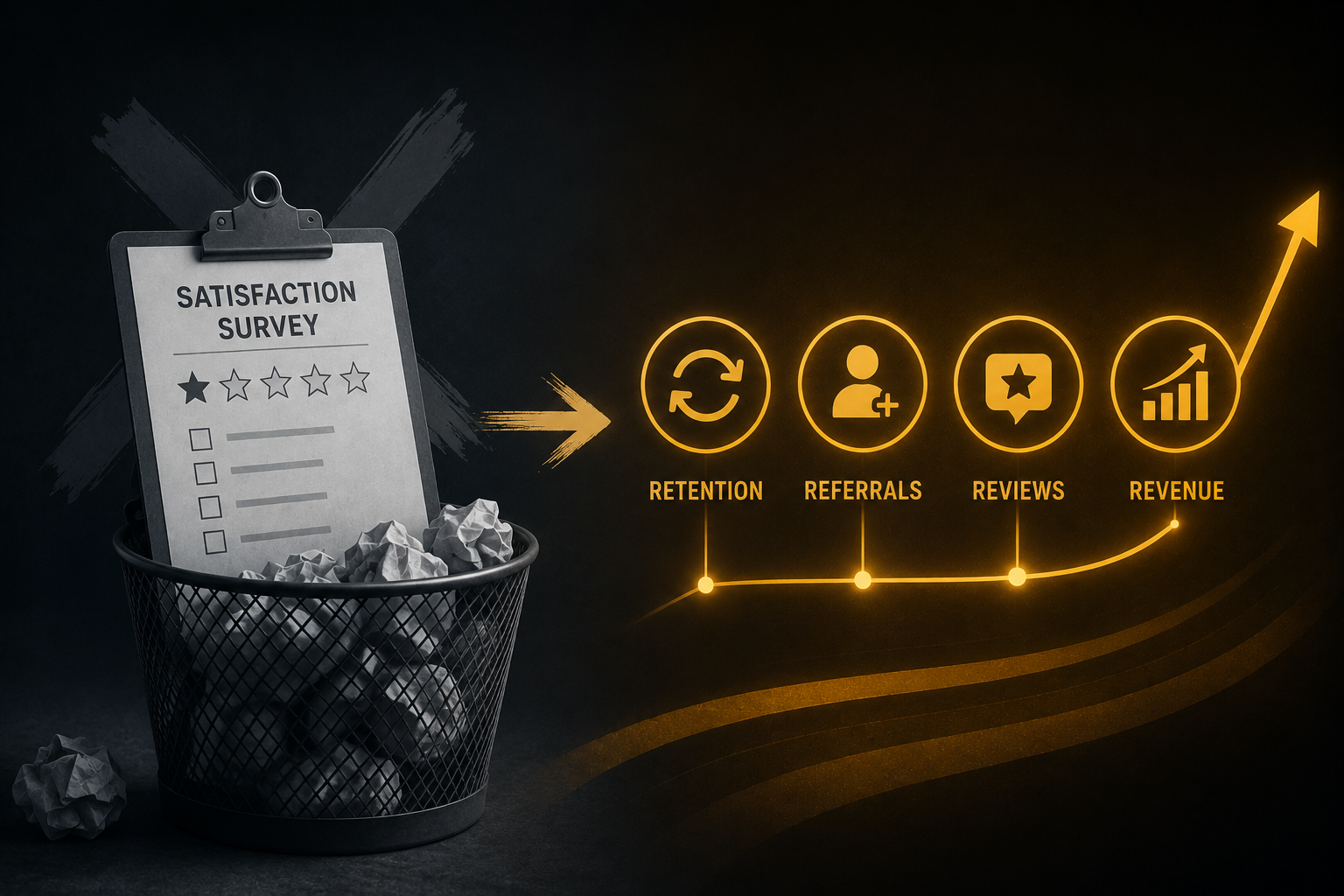
Traditional customer satisfaction surveys are nearly useless for home service businesses. They measure the wrong things, barely anyone answers them, and they arrive too late to fix anything. What actually matters isn’t whether a customer was satisfied, it’s whether they’re loyal enough to come back and refer you. Track the behaviors that predict that, retention, referrals, reviews, and catch problems in real time while you can still fix them, and you’ll finally be measuring what drives money.
That’s the whole thing. Let me open it up, because most contractors are measuring the wrong stuff and flying blind on the stuff that matters.
The Survey Problem
Let’s start by killing a sacred cow. The customer satisfaction survey, the way most contractors do it, is close to worthless. I know that sounds harsh, but stay with me, because understanding why it fails points you straight at what actually works.
Here’s the first problem: almost nobody answers them. You send out a survey after a job, and a tiny fraction of customers ever fill it out. And the ones who do tend to be the extremes, the people who are furious or the people who are thrilled. The huge middle, the customers who quietly matter most, never respond. So you’re making decisions based on a handful of responses from the loudest people, and calling it data. That’s not a real read on your business. That’s noise from the edges.
Second problem: they measure the wrong things. Most surveys ask vague, feel-good questions that don’t actually predict anything. “Were you satisfied with your service?” Okay, they clicked “yes.” So what? That tells you almost nothing about whether they’ll ever call you again or send you a single referral. You collected a warm fuzzy that has no connection to money.
Third problem, and this is the big one: they arrive too late. A survey that shows up a week or a month after the job is like driving your business by staring in the rearview mirror. By the time you find out a customer had a bad experience, the job’s long done, the moment to fix it has passed, and the damage is already baked in. You learned about the problem when it was far too late to do anything about it. You need to be looking through the windshield at what’s happening now, not squinting in the rearview at what already went wrong.
So the standard survey is low-response, measures the wrong thing, and comes too late. Three strikes. Time to throw out the whole approach and build something that actually tells you the truth in time to use it. And it starts with understanding what you should actually be measuring.
Satisfied Is Not the Same as Loyal
Here’s the single most important idea in this whole article, and once it clicks, you’ll never think about “customer satisfaction” the same way again. Satisfied and loyal are two completely different things, and you’ve been chasing the wrong one.
A satisfied customer is simply a customer who has no complaint. The job got done, nothing went obviously wrong, they’re fine. That’s all “satisfied” means. And here’s the trap: satisfied customers leave all the time. They shop around, they take the cheaper quote next time, they forget your name the moment they need you again, and they’d never think to refer you to anyone. They were satisfied, and they’re gone. Because “no complaint” is a low bar, and clearing a low bar doesn’t earn you anything durable. Satisfaction is the floor. It just means you didn’t screw up badly enough to make them mad.
A loyal customer is a completely different animal. A loyal customer comes back to you again and again without shopping around. A loyal customer refers their friends and neighbors and family to you. A loyal customer defends you, trusts you, and is worth a fortune over the years. Loyalty is the goal. And the gap between satisfied and loyal is enormous, which is exactly why measuring satisfaction is such a waste. You can have a business full of “satisfied” customers who feel no real connection to you and would leave for a coupon, and your satisfaction scores would look great right up until you wonder why nobody’s calling back.
So stop measuring satisfaction. It’s the floor, and the floor doesn’t predict anything worth knowing. Start measuring loyalty, because loyalty is what actually drives repeat business, referrals, and lifetime value. The whole game is moving customers from merely satisfied to genuinely loyal, and you can’t manage that if you’re not even measuring the right thing. So what does measuring loyalty actually look like? Let me show you.
Measure Behavior, Not Feelings
Here’s the shift that changes everything about how you track this. Stop measuring what customers say, and start measuring what they do. Attitudes lie. Behavior tells the truth.
A customer can click “very satisfied” on a survey and never call you again. Words are cheap and people are polite. But behavior doesn’t lie. When a customer actually calls you back for the next job, that’s loyalty you can see. When a customer actually sends you a referral, that’s loyalty with money attached. When a customer actually leaves you a review, that’s loyalty made public. These behaviors are the real measure, because they’re what customers do with their own time and money and reputation, not just what they clicked to be nice. So build your measurement around behavior, and here are the metrics that actually matter.
Retention, or repeat rate. What percentage of your customers come back to you for their next job instead of going elsewhere? This is one of the truest measures of loyalty there is, because it’s customers voting with their wallets, over and over. A high repeat rate means you’re building real loyalty. A low one means you’re churning through customers no matter how “satisfied” they claimed to be. Track it, because it’s the heartbeat of a healthy business.
Referral rate. How many of your new customers are coming from referrals by existing ones? Referrals are loyalty at its purest, because a customer is putting their own reputation on the line to recommend you. A strong, growing referral rate means you’re creating genuinely loyal customers who love you enough to send their friends. If nobody’s referring you, no survey score matters, because the behavior is telling you the loyalty isn’t there.
Review generation. How many customers are willing to publicly vouch for you with a review? This is loyalty made visible to the whole market, and it doubles as one of your most powerful marketing assets, as I’ve written before. Track how many reviews you’re generating, because a customer taking the time to publicly praise you is showing real loyalty, and it feeds your growth on top of measuring it.
These behavioral metrics beat any satisfaction survey, because they measure what customers actually do, and what they do is what pays your bills. Track retention, referrals, and reviews, and you’re finally measuring the loyalty that predicts lifetime value instead of a feel-good number that predicts nothing.
The One Question Worth Asking
Now, I’m not saying never ask customers anything. There’s one question worth asking, because it predicts loyalty better than any satisfaction question, and it’s widely used for exactly that reason. It’s the referral question: how likely are you to recommend us to a friend or neighbor?
Why does this one question work when “were you satisfied” doesn’t? Because it forces the customer to put their own reputation on the line, at least hypothetically. It’s easy to say you were satisfied. It’s a bigger deal to say you’d actively recommend someone to your friends, because now your own name is attached to it. That question gets much closer to real loyalty than any satisfaction question, which is why so many great companies build their whole feedback system around it. Someone who enthusiastically says they’d recommend you is loyal. Someone who’s lukewarm on that question is a customer you’re about to lose, even if they’d have clicked “satisfied.”
But here’s the crucial part most people miss, and it ties back to measuring behavior over words. The answer to the recommend question is a useful signal, but what matters even more is whether they actually do it. Asking if they’d recommend you is good. Tracking whether referrals actually show up is better. So use the question as an early read on loyalty, but always anchor your real measurement in the behavior, the actual referrals, the actual repeat calls, the actual reviews. The question predicts. The behavior confirms. Watch both, and weight the behavior heavier, because talk is cheap and action is truth.
Build a Real-Time Feedback Loop
Now let’s fix the timing problem, because this is where you turn measurement into something that actually improves your business instead of just scoring it after the fact.
Remember the rearview mirror. The fatal flaw of the traditional survey is that it arrives too late to fix anything. So the fix is to move your feedback to real time, right at the moment of service or immediately after, while you can still do something about it. This is the difference between measuring problems and preventing them.
Here’s what that looks like. Instead of a survey that lands weeks later, you check in with the customer right at the end of the job or immediately after, while the tech is still there or within the hour. A quick, genuine “are you completely happy with everything today?” from the tech before he leaves. A fast automated message right after the job that makes it easy to flag any issue immediately. The whole point is to catch any problem while it’s still fresh and still fixable, before it hardens into a lost customer or a bad review.
And this is where real-time feedback becomes gold, because it connects straight to the friction-free callback and the make-it-right mindset I’ve written about. When you catch a problem in real time, you can jump on it immediately, fix it, and turn a would-be unhappy customer into a loyal one who’s blown away by how fast you made it right. That’s not just measurement, that’s a save, and saves build the deepest loyalty there is. A problem caught in real time and fixed beautifully creates a more loyal customer than a job that went perfectly. But you can only do that if you’re looking through the windshield, catching it now, instead of finding out from a survey a month later when the customer’s already gone and warning their neighbors.
So build the real-time loop: a genuine check at the end of every job, an immediate easy channel to flag issues, and a fast, gracious response when something comes up. That system does double duty. It measures your real quality in the moment, and it lets you fix problems while fixing them still matters.
Watch the Right Scoreboard
Let me pull this together into how you should actually think about measurement, because a lot of contractors either measure nothing or measure a pile of vanity numbers that feel good and mean nothing.
Think of it like a scoreboard. You want the few numbers on it to be the ones that actually predict whether you’re winning, meaning building loyalty and lifetime value, not the ones that just look nice. Your satisfaction survey score is a vanity number. It feels good and predicts nothing. Your retention rate, your referral rate, and your review generation are the real score, because they measure loyalty in behavior, and loyalty is what drives the money.
So build a simple scoreboard of the metrics that matter and actually watch it. Not a hundred numbers, just the handful that tell the truth. Are customers coming back? Are they referring? Are they reviewing? Are we catching and fixing problems in real time? Those questions, tracked consistently, tell you far more about the health of your business than any stack of survey responses ever could. This is the same stop-guessing, measure-what-matters discipline I preach on everything, applied to customer loyalty. Watch the real scoreboard, ignore the vanity numbers, and you’ll always know where you actually stand.
How to Roll This Out Starting Monday
Same rhythm as always. One piece at a time.
Week one: start tracking the behaviors that matter. Begin measuring your retention rate, your referral rate, and your review generation. Even a rough starting number is fine. You can’t improve what you don’t measure, so get these real behavioral metrics on your scoreboard first, and retire the vanity satisfaction score.
Week two: build the real-time check. Train your techs to genuinely check in with the customer at the end of every job, before they leave, so any problem surfaces while it’s still fresh and fixable. Turn feedback from a rearview-mirror survey into a windshield conversation happening in the moment.
Week three: add the immediate feedback channel and fast response. Set up a quick, easy way for customers to flag any issue right after the job, and commit to jumping on problems immediately and graciously to make them right. Use real-time feedback to save relationships, not just score them.
Week four: build the scoreboard and watch it. Put your handful of loyalty metrics in one simple place and start reviewing them on a regular cadence. Retention, referrals, reviews, problems caught and fixed. Make watching the real scoreboard a habit, and use it to drive real improvements in how you build loyalty.
Four weeks to stop measuring the wrong thing and start measuring what actually predicts a thriving business. Because a great service call was never about a customer clicking “satisfied.” It was about earning a customer loyal enough to come back and bring their friends, and now you can actually measure whether you’re doing it.
Frequently Asked Questions
Why are customer satisfaction surveys not useful for contractors? Because they fail three ways. Almost nobody answers them, so you get skewed data from only the extremes. They measure vague satisfaction that doesn’t predict whether a customer will return or refer you. And they arrive weeks after the job, too late to fix anything. You end up making decisions on noisy, meaningless data about problems you can no longer solve.
What’s the difference between a satisfied customer and a loyal one? A satisfied customer simply has no complaint, which is a low bar they can clear and still leave, shop around, or forget you. A loyal customer comes back repeatedly, refers friends, and trusts you, and is worth far more over time. Satisfaction is the floor, loyalty is the goal, and the gap between them is huge, which is why measuring satisfaction predicts so little.
What should contractors measure instead of satisfaction? Behavior, not stated feelings. Track your retention or repeat rate, your referral rate, and your review generation, because these measure what customers actually do with their money, reputation, and time. Behavioral metrics reveal real loyalty, while a survey score reveals only politeness. What customers do predicts lifetime value, what they click on a survey predicts almost nothing.
What’s the best single question to ask customers? How likely they are to recommend you to a friend or neighbor. It predicts loyalty far better than asking about satisfaction, because recommending you puts the customer’s own reputation on the line. But treat the answer as an early signal and anchor your real measurement in whether referrals, repeat calls, and reviews actually happen. The question predicts, the behavior confirms.
How do I catch service problems in time to fix them? Move feedback to real time. Have techs genuinely check with the customer before leaving the job, and set up an easy way to flag issues immediately after. Then respond fast and graciously to make it right. Catching a problem in the moment lets you fix it while it still matters, which often creates a more loyal customer than a job that went perfectly.
The Bottom Line
Stop measuring whether your customers are satisfied. It’s a vanity number that predicts nothing, gathered from too few people, too late to matter. Satisfaction is just the floor, the absence of a complaint, and satisfied customers leave you all the time.
Measure loyalty instead, and measure it in behavior. Track whether customers actually come back, actually refer you, and actually review you, because that’s loyalty you can see and loyalty is what drives lifetime value. Ask the recommend question as an early signal, but trust the behavior over the words. And build a real-time feedback loop so you catch problems through the windshield while you can still fix them, not in the rearview when it’s too late.
A great service call isn’t a customer who clicked “satisfied.” It’s a customer loyal enough to come back and bring their friends. Measure that, on a simple scoreboard you actually watch, and you’ll finally know whether you’re building the business you think you are.
If you want help building the measurement systems that show you what’s really driving loyalty and growth in your business, that’s the work we do with contractors every day. Book a free strategy session and let’s build your scoreboard.
Josh Kelly is Co-Founder of Clover Growth Partners, where he helps home service contractors build businesses that grow without depending on them being in every truck.