
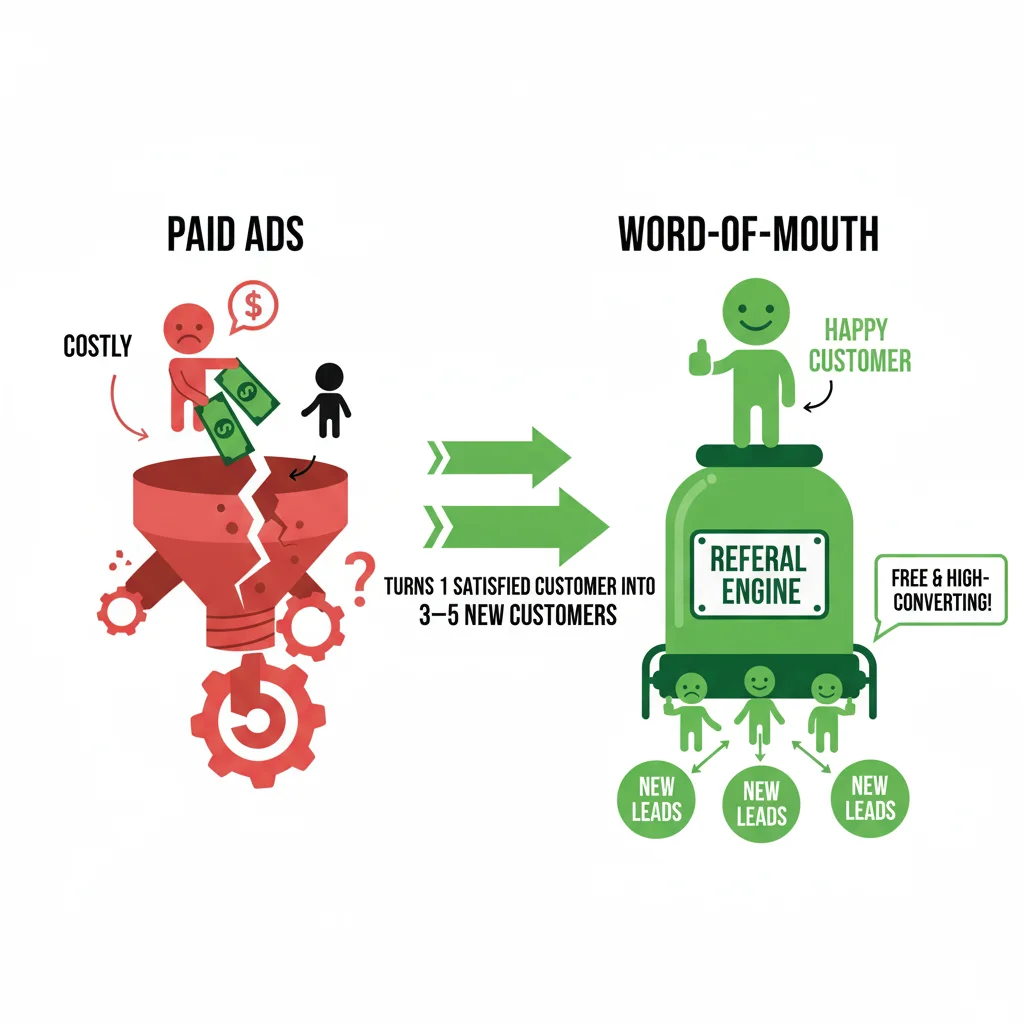
Here’s something that’s going to blow your mind: The average satisfied customer tells 3-5 people about good service experiences. But only 23% of contractors have any systematic process for generating, tracking, or maximizing referrals.
Think about that for a second. Your best customers are naturally motivated to send you business, but most contractors just hope it happens instead of making sure it happens.
Meanwhile, I see contractors spending thousands on Google Ads and Facebook marketing to generate leads that cost $75-$150 each, while completely ignoring the referral opportunities sitting right in front of them that cost essentially nothing to generate.
Here’s what drives me crazy: Word-of-mouth referrals close at an 85% rate and have a customer lifetime value that’s 16% higher than other lead sources. Yet most contractors treat referrals like lucky accidents instead of the predictable business system they could be.
The contractors who master systematic referral generation don’t just get occasional word-of-mouth business—they build referral machines that consistently generate 30-50% of their new customers through structured, repeatable processes.
The $200,000 Missed Opportunity
Let me hit you with some numbers that’ll make you rethink everything about referral marketing.
The Referral Value Math:
- Average contractor generates 15-20% of new business through referrals
- Systematic referral contractors generate 40-60% through referrals
- On a $2M business, that’s the difference between $300,000 and $1,000,000 in referral-generated revenue
- Missed opportunity: $700,000 annually
The Cost Comparison Reality:
- Paid advertising leads cost $75-$200 each
- Referral leads cost $15-$25 each (including incentive costs)
- Referrals close at 85% vs. 35% for paid leads
- Referral customers have 23% higher lifetime value
The Compound Effect: Happy referral customers generate their own referrals. One systematic referral customer can generate 8-12 additional customers over their lifetime relationship with you.
Yet most contractors have no systematic process for turning satisfied customers into referral generators.
The Psychology of Referral Generation
Before we dive into systems and tactics, let’s understand what actually motivates customers to refer your services.
The Helper’s High: People feel good about helping others solve problems. When customers refer your services, they’re not just helping you—they’re helping friends and neighbors who need reliable service providers.
Social Status and Expertise: Being the person who knows “the best contractor in town” gives customers social status and positions them as helpful experts in their social circles.
Reciprocity and Relationship: Customers who receive exceptional service feel obligated to reciprocate by helping your business succeed. This reciprocity drive is powerful but only activated by truly exceptional service experiences.
Risk Reduction for Friends: When customers refer your services, they’re reducing their friends’ risk by recommending someone they trust. This positions them as helpful and caring friends.
The Trust Transfer: Referrals work because trust transfers from the existing customer to the potential customer. This transferred trust is incredibly valuable and accelerates the sales process.
The Five-Phase Referral Machine System
Here’s how to build a systematic referral generation system that consistently turns satisfied customers into active promoters:
Phase 1: Referral Foundation – Creating Referral-Worthy Experiences
You can’t build a referral machine without creating experiences worth referring. This goes beyond basic customer satisfaction to creating memorable, share-worthy service experiences.
The Surprise and Delight Strategy:
Exceeded Expectations Protocol:
- Under-promise, Over-deliver: Set reasonable expectations, then exceed them
- Bonus Value: Include unexpected value additions that surprise customers
- Speed Surprises: Complete work faster than promised when possible
- Quality Surprises: Deliver higher quality than customer expected
Memorable Service Elements:
- Personal Touches: Remember customer preferences and personal details
- Problem Prevention: Identify and fix potential problems before they occur
- Educational Value: Teach customers about their systems and maintenance
- Follow-up Excellence: Systematic follow-up that demonstrates ongoing care
Professional Presentation Standards:
- Vehicle Presentation: Clean, professional, well-branded vehicles
- Technician Appearance: Professional uniforms, clean presentation, courteous behavior
- Work Area Respect: Protective coverings, cleanup, respect for customer property
- Communication Excellence: Clear, professional communication throughout service process
Service Recovery Excellence: When problems occur (and they will), turn them into referral opportunities:
- Immediate Response: Address problems quickly and professionally
- Over-compensation: Provide more value than the problem cost
- Learning and Improvement: Show how you’ve improved processes to prevent future issues
- Follow-up Verification: Ensure complete customer satisfaction with problem resolution
Phase 2: Strategic Referral Requests – The Art and Science of Asking
Most contractors never ask for referrals, and those who do ask poorly. Here’s how to systematically request referrals in ways that generate results.
The Optimal Timing Strategy:
Peak Satisfaction Moments:
- Project Completion: Immediately after successful project completion
- Problem Resolution: After resolving a challenging issue exceptionally well
- Maintenance Success: During positive maintenance interactions
- Positive Feedback: When customers voluntarily express satisfaction
Follow-up Timing:
- 24-48 Hours: After completion, when satisfaction is still fresh
- 1 Week Later: After customer has experienced full benefit of service
- Seasonal Reminders: During relevant seasonal maintenance or service needs
- Anniversary Dates: Annual reminders of successful project completion
The Request Framework:
Permission-Based Approach: “I’m grateful you’re happy with our work. Would you mind if I asked you to help us help other homeowners who might need similar services?”
Specific Request Strategy: Instead of “Do you know anyone who might need our services?” try: “Do you know anyone who’s been frustrated with their current HVAC contractor?” or “Have any of your neighbors mentioned needing electrical work?”
Multiple Contact Method Requests:
- In-person requests during service completion
- Follow-up phone calls 24-48 hours after service
- Email requests with easy referral sharing tools
- Text message requests with contact information
Value-First Approach: “If you know anyone dealing with [specific problem you just solved], I’d love to help them the same way I helped you.”
Phase 3: Incentive Systems – Making Referrals Rewarding
Well-designed incentive systems motivate referrals while maintaining professionalism and avoiding the appearance of “buying” referrals.
The Dual-Benefit Strategy:
Customer Incentives:
- Service Credits: $50-$100 service credit for successful referrals
- Cash Rewards: Direct cash payments for completed referral jobs
- Service Upgrades: Free service upgrades or maintenance for referring customers
- VIP Treatment: Priority scheduling and special treatment for top referrers
Referred Customer Benefits:
- New Customer Discounts: Special pricing for referred customers
- Enhanced Service: Bonus services or extended warranties for referrals
- Fast-Track Service: Priority scheduling for referred customers
- Special Packages: Exclusive service packages only available through referrals
Tiered Incentive Systems:
Bronze Level (1-2 Referrals per Year):
- $50 service credit per successful referral
- 10% discount on annual maintenance
- Priority scheduling preference
Silver Level (3-5 Referrals per Year):
- $75 service credit per successful referral
- Free annual system inspection
- Guaranteed same-day emergency response
Gold Level (6+ Referrals per Year):
- $100 service credit per successful referral
- Free annual maintenance service
- Lifetime priority customer status
- Exclusive access to new services and technology
Professional Incentive Presentation:
Instead of saying: “We’ll pay you for referrals” Say: “We’d like to thank customers who help us help others by offering service credits for successful referrals.”
Phase 4: Systematic Follow-up and Relationship Nurturing
Building customer lifetime value requires systematic relationship nurturing that keeps you top-of-mind when referral opportunities arise.
The Ongoing Relationship Strategy:
Regular Communication Schedule:
- Immediate Follow-up: 24-48 hours after service completion
- One Week Check-in: Ensure continued satisfaction and system performance
- One Month Touch: Maintenance reminders and additional service opportunities
- Quarterly Contact: Seasonal maintenance reminders and check-ins
- Annual Relationship: Birthday cards, holiday greetings, anniversary acknowledgments
Value-Added Communication:
- Educational Content: Helpful maintenance tips and seasonal advice
- Safety Reminders: Important safety information and system alerts
- Efficiency Tips: Ways to improve system performance and reduce costs
- New Service Announcements: Information about new services that might benefit them
Community Engagement Integration:
- Local Event Invitations: Invite best customers to community events you sponsor
- Customer Appreciation Events: Annual customer appreciation gatherings
- Educational Workshops: Home maintenance workshops for customers and their friends
- Community Involvement Updates: Share your community involvement and charitable activities
Referral Reminder Integration: Build referral requests into regular communication:
- Maintenance Reminders: “While we’re there, ask if your neighbors need similar service”
- Seasonal Communications: “Spring is when many homeowners need [your service]”
- Newsletter Content: “Here’s how to help friends find reliable contractors”
- Holiday Communications: “The gift of reliable service: refer friends to trusted contractors”
Phase 5: Referral Tracking and Optimization
What gets measured gets managed. Systematic referral tracking allows you to optimize your referral generation system for maximum results.
Referral Source Tracking:
Customer Source Analysis:
- Which customers generate the most referrals?
- What characteristics do top referrers share?
- Which services generate the most referral activity?
- What timing generates the most referral responses?
Referral Method Effectiveness:
- In-person requests vs. phone vs. email vs. text effectiveness
- Incentive levels and their impact on referral generation
- Communication timing and frequency optimization
- Follow-up method effectiveness measurement
Conversion Tracking:
- Referral-to-lead conversion rates
- Referral lead-to-customer conversion rates
- Referral customer lifetime value analysis
- Referral customer satisfaction and retention rates
ROI Analysis:
- Cost per referral generated (including incentive costs)
- Revenue per referral compared to other lead sources
- Profit margin analysis for referral-generated business
- Long-term value of referral customers vs. other sources
Advanced Referral Strategies
Once you’ve mastered the basic referral system, here are advanced strategies for maximizing referral generation:
The Neighborhood Referral Network Strategy
Geographic Concentration Approach: Instead of scattered individual referrals, build concentrated referral networks in specific neighborhoods.
Implementation Tactics:
- Neighborhood Specialization: Become the go-to contractor for specific subdivisions
- Community Event Participation: Sponsor and participate in neighborhood events
- Homeowner Association Relationships: Build relationships with HOA leaders and board members
- Next-Door Neighbor Strategy: Systematically approach neighbors during service calls
Benefits:
- Referral Concentration: Multiple referrals from same geographic area
- Service Efficiency: Reduced travel time between referral customers
- Community Reputation: Become known as “the neighborhood contractor”
- Word-of-Mouth Amplification: Referrals generate additional referrals in concentrated areas
The Strategic Partner Referral System
Professional Referral Networks: Build systematic referral relationships with complementary professionals who serve the same customer base.
Key Referral Partners:
- Real Estate Agents: New homeowners need multiple home services
- Insurance Adjusters: Property damage creates service opportunities
- Property Managers: Ongoing maintenance and repair needs
- General Contractors: Specialty trade referrals for projects outside their expertise
- Home Inspectors: Inspection findings create service opportunities
Partner Relationship Development:
- Value Proposition: Clear benefits for partners who refer business
- Reciprocal Referrals: Refer business to partners when appropriate
- Professional Recognition: Acknowledge and thank partners for referrals
- Communication Systems: Easy ways for partners to make referrals
- Quality Assurance: Ensure exceptional service for partner-referred customers
The Social Media Referral Amplification Strategy
Digital Referral Enhancement: Use social media to amplify and facilitate traditional referral processes.
Social Proof Creation:
- Customer Success Stories: Share customer testimonials and project photos
- Before/After Documentation: Visual proof of service quality and results
- Customer Appreciation Posts: Publicly thank customers for referrals and loyalty
- Community Involvement: Show community engagement and local connection
Easy Sharing Systems:
- Social Media Integration: Make it easy for customers to share positive experiences
- Review Platform Connections: Guide satisfied customers to online review platforms
- Referral Landing Pages: Custom pages that make referrals easy to submit
- Mobile-Optimized Systems: Referral tools that work on smartphones and tablets
Case Studies: Referral Machine Success Stories
Case Study 1: Premier Plumbing Solutions (Austin, TX)
Challenge: New plumbing business in competitive Austin market, needed cost-effective customer acquisition strategy.
Referral System Implementation:
Phase 1: Foundation Building
- Service Excellence Focus: Invested heavily in training and customer service systems
- Professional Presentation: Upgraded uniforms, vehicles, and all customer touchpoints
- Follow-up System: Implemented systematic post-service follow-up and satisfaction verification
Phase 2: Systematic Referral Requests
- Timing Optimization: Trained technicians to request referrals at peak satisfaction moments
- Script Development: Created natural, professional referral request scripts
- Multiple Touchpoint Strategy: Referral requests through phone, email, and text
- Permission-Based Approach: Always asked permission before requesting referrals
Phase 3: Incentive Program
- Dual Benefit System: $75 credit for referring customer, $50 discount for referred customer
- Tiered Rewards: Increasing benefits for customers who made multiple referrals
- Professional Presentation: Positioned incentives as “thank you” rather than “payment”
- Easy Redemption: Simple process for using referral credits
Phase 4: Relationship Nurturing
- Quarterly Communication: Regular check-ins and maintenance reminders
- Educational Content: Helpful home maintenance tips and seasonal advice
- Community Involvement: Sponsored local youth sports and community events
- Customer Appreciation: Annual customer appreciation barbecue
Results After 18 Months:
- Referral Percentage: 47% of new customers came through referrals
- Business Growth: Grew from startup to $1.2M annual revenue
- Customer Acquisition Cost: Reduced from $95 per lead to $23 per referral lead
- Closing Rate: 89% closing rate on referral leads vs. 34% on paid advertising leads
- Customer Satisfaction: 96% customer satisfaction rate with systematic service approach
- Referral ROI: 1,840% return on referral system investment
Case Study 2: Mountain Air HVAC (Denver, CO)
Challenge: Established HVAC business struggling with rising advertising costs and declining lead quality from paid advertising.
Referral Transformation Strategy:
Current State Analysis:
- Referral Baseline: Only 18% of business from referrals despite 15 years in business
- Advertising Dependence: 65% of leads from expensive pay-per-click advertising
- Customer Satisfaction: High satisfaction but no systematic referral process
- Missed Opportunities: No tracking or systematic approach to referral generation
Systematic Referral Implementation:
Customer Database Analysis:
- Satisfaction Segmentation: Identified most satisfied customers for referral focus
- Service Analysis: Determined which services generated highest satisfaction
- Geographic Analysis: Mapped customer locations for neighborhood concentration strategy
- Communication Preferences: Identified preferred communication methods for referral requests
Referral Process Development:
- Technician Training: 20 hours of training on natural referral request techniques
- Customer Journey Mapping: Identified optimal moments for referral requests
- Follow-up Systematization: Automated follow-up sequences with referral requests
- Incentive Program: Launched tiered incentive program with meaningful rewards
Neighborhood Network Strategy:
- Geographic Concentration: Focused referral efforts in neighborhoods with existing customers
- Community Engagement: Increased participation in local community events
- HOA Relationships: Built relationships with homeowner association leaders
- Seasonal Campaigns: Launched neighborhood-specific seasonal maintenance campaigns
Results After 24 Months:
- Referral Growth: Increased referrals from 18% to 52% of new business
- Revenue Impact: $600,000 increase in annual revenue
- Cost Reduction: Reduced advertising spend by 40% while increasing total leads
- Lead Quality: 92% closing rate on referral leads vs. 28% on advertising leads
- Customer Lifetime Value: Referral customers had 31% higher lifetime value
- Profit Margin: Overall profit margins increased by 12% due to lower acquisition costs
- Geographic Concentration: Built 60%+ market share in 3 target neighborhoods
Technology Tools for Referral Management
Essential Referral Technology Systems:
Customer Relationship Management (CRM) Integration:
- Referral Tracking: Track referral sources, methods, and success rates
- Communication Automation: Automated referral request sequences
- Incentive Management: Track incentive distribution and redemption
- Performance Analytics: Measure referral program effectiveness
Digital Referral Tools:
- Online Referral Forms: Easy-to-use web forms for referral submission
- Mobile-Optimized Systems: Referral tools that work on smartphones
- Social Media Integration: Easy sharing of positive experiences
- Email Templates: Professional referral request email templates
Communication Platforms:
- Text Message Systems: SMS-based referral requests and reminders
- Email Marketing: Automated email sequences with referral requests
- Voice Broadcasting: Automated follow-up calls with referral requests
- Social Media Tools: Tools for managing social proof and customer stories
Analytics and Tracking:
- Referral Source Attribution: Track which customers generate most referrals
- Conversion Analytics: Measure referral-to-customer conversion rates
- ROI Calculation: Calculate return on investment for referral programs
- Performance Optimization: Identify and optimize highest-performing referral strategies
Financial Modeling for Referral Systems
Investment vs. Return Analysis:
Referral System Investment:
- Training Investment: Staff training on referral request techniques ($2,000-$5,000)
- Technology Systems: CRM and referral management tools ($2,000-$8,000 annually)
- Incentive Budget: Customer referral rewards (2-4% of referral revenue)
- Marketing Materials: Referral program materials and communication ($1,000-$3,000)
- Administrative Time: Time spent managing referral relationships and follow-up
Revenue Impact Calculation:
$2M Annual Revenue Contractor Example:
- Current Referrals: 20% of business = $400,000 referral revenue
- Systematic Referral Target: 45% of business = $900,000 referral revenue
- Revenue Increase: $500,000 additional referral revenue
- Cost Savings: Reduced advertising spend = $75,000 savings
- Total Financial Impact: $575,000 annual improvement
Cost Analysis:
- System Investment: $15,000 first-year investment
- Ongoing Incentives: $36,000 annual incentive costs (4% of referral revenue)
- Total Costs: $51,000 annual cost
ROI Calculation:
- Net Benefit: $575,000 – $51,000 = $524,000
- Return on Investment: 1,027% annual ROI
Common Referral System Mistakes and Solutions
Mistake 1: Inconsistent Referral Requests Some contractors ask for referrals sporadically, missing most opportunities.
Solution: Build referral requests into systematic customer interaction processes. Every satisfied customer should receive a referral request.
Mistake 2: Awkward or Pushy Referral Requests Contractors who ask for referrals in ways that make customers uncomfortable.
Solution: Train staff on natural, permission-based referral request techniques that focus on helping others rather than getting business.
Mistake 3: No Follow-Through on Referral Promises Failing to deliver promised incentives or follow up with referring customers.
Solution: Create systematic processes for tracking referral incentives and maintaining relationships with referring customers.
Mistake 4: Focusing Only on Quantity Over Quality Encouraging any referrals instead of focusing on qualified, high-value referral opportunities.
Solution: Train customers to identify good referral opportunities and provide guidance on when and how to make referrals.
Mistake 5: No Referral Performance Tracking Operating referral programs without measuring effectiveness or optimizing performance.
Solution: Implement systematic tracking and measurement systems to identify what works and optimize referral generation strategies.
Building Your 90-Day Referral Machine
Days 1-30: Foundation and Assessment
- Current State Analysis: Evaluate existing referral generation and identify opportunities
- Customer Satisfaction Audit: Ensure service quality supports referral generation
- Staff Training: Train team on referral request techniques and customer service excellence
- System Setup: Implement basic referral tracking and communication systems
Days 31-60: Program Launch and Optimization
- Referral Process Implementation: Launch systematic referral request processes
- Incentive Program: Implement referral incentive and reward systems
- Communication Integration: Build referral requests into regular customer communication
- Partner Network Development: Begin building strategic referral partnerships
Days 61-90: Scaling and Advanced Strategies
- Performance Analysis: Analyze referral generation results and optimize approaches
- Advanced Strategy Implementation: Launch neighborhood concentration and social media amplification
- System Refinement: Optimize referral processes based on initial results
- Expansion Planning: Plan expansion of referral system to additional customer segments
Ready to Build Your Referral Machine?
Look, here’s the reality: Your satisfied customers are already thinking about referring your services. The question is whether you’re going to leave those referrals to chance or build a systematic machine that captures and maximizes every referral opportunity.
Every day you operate without a systematic referral process is another day you’re paying premium prices for leads you could be getting for free from customers who already trust and value your services.
The contractors who dominate their markets don’t just hope for referrals—they build systematic machines that consistently generate high-quality leads from their best customers.
Ready to stop leaving referrals to chance and start systematically generating them?
Let’s talk about building a referral machine that turns your satisfied customers into consistent lead generation systems.
Because word-of-mouth marketing is too valuable to leave to accident, and your satisfied customers are too motivated to ignore.