
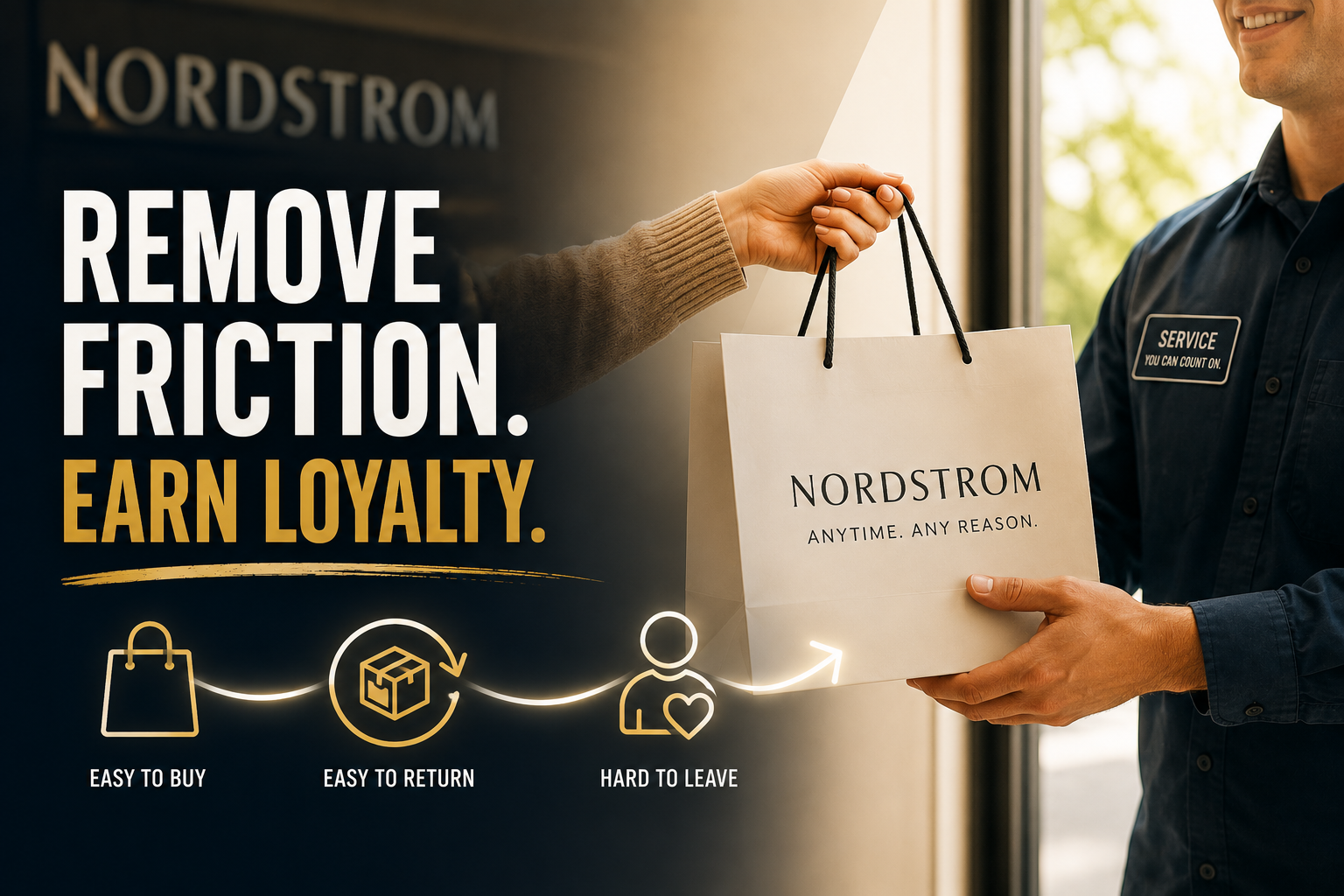
Nordstrom became famous for one simple idea: make it absurdly easy to do business with them, especially when something goes wrong. That friction-free approach costs a little on any single transaction and makes a fortune over a customer’s lifetime. The same math works in home services. Handle callbacks, warranty calls, and guarantees with zero hassle and you build loyalty your restrictive competitors can’t touch.
That’s the whole idea. Now let me show you how to steal it.
The Tire Story
There’s a legend about Nordstrom that’s been told in business circles for decades. A man walks into a Nordstrom and returns a set of tires. Gets his money back, no argument. The punchline is that Nordstrom has never sold tires. Not ever. The store just took them back and refunded him anyway, because the site used to be a tire shop and the customer thought that’s where he bought them.
Now, is that story exactly true? Probably embellished over the years. Legends usually are. But the reason it’s survived this long, the reason people still tell it, is that it captures something real about how Nordstrom actually operated. They built their whole reputation on being the company that says yes when everybody else says “let me check the policy.”
And here’s the piece of Nordstrom lore that isn’t a legend. For years, their entire employee handbook reportedly boiled down to one line. Use good judgment in all situations. There are no additional rules. Think about the trust in that. No forty-page policy manual on returns. No rulebook for every situation. Just: you’re a smart adult, take care of the customer, use your head. That’s it.
Compare that to how most businesses operate. Most businesses build walls. Rules on top of rules, all designed to stop the rare person who might take advantage. And in doing it, they make life miserable for the ninety-eight percent of customers who’d never dream of cheating them. Nordstrom went the other way. They bet on people. They removed the friction. And they got rich doing it.
The question for you is simple. What would it look like to run your home service business the Nordstrom way? Let me walk you through it.
Friction Is the Silent Killer
First you have to understand what friction actually is, because it hides in places you’ve stopped noticing.
Friction is every little bit of resistance, hassle, and annoyance a customer hits when they try to do business with you. It’s the hoops. The waiting. The “that’s not our policy.” The making them prove it. The sigh on the other end of the phone when they call back about a problem. Every one of those is a tiny bit of sand in the gears of the relationship, and sand adds up.
Here’s why it’s so dangerous. Friction almost never shows up on any report you look at. You’ll never see a line item that says “lost customer because the callback process felt like a fight.” You just quietly lose people, and you blame the market, or the economy, or the cheap competition, when the real reason is that doing business with you felt like work, and doing business with the other guy felt easy.
The thing about friction is that you built most of it to protect yourself. That’s the trap. Somewhere along the way a customer took advantage of you, and it stung, so you made a rule. Then it happened again in a different way, so you made another rule. And over the years you built a fortress of policies, each one designed to stop the rare bad actor, and every single one of those walls is now standing between you and every good customer you’ve got.
You built the fortress to keep the bad people out. But the bad people are two percent of the traffic. The other ninety-eight percent are good people who now have to climb your walls just to give you money and stay loyal. That’s a terrible trade, and most owners never see they’re making it.
Nordstrom saw it. They tore the walls down on purpose. Let’s do the same, starting with the moment that matters most.
The Callback Is the Whole Ballgame
In home services, the highest-friction, highest-stakes moment in the entire relationship is the callback. Something you fixed didn’t hold. A part failed. The customer isn’t happy. They’re calling back.
How you handle that one moment decides everything. And most contractors handle it exactly wrong.
Here’s the wrong way, and you’ve probably felt yourself do it. The callback comes in and the whole company tenses up. The instinct is defense. Was it really our fault? Is this covered? Did the tech document it? The customer can feel all of that through the phone. They called already a little worried and maybe a little annoyed, and now they’re getting a vibe that they’re being treated like a suspect instead of a customer. The conversation becomes a negotiation. A little cold. A little “well, technically.” And even if you end up fixing it for free, the customer walks away feeling like they had to fight you for it. That feeling is what they remember. That feeling is what they tell people about.
Now here’s the Nordstrom way. The callback comes in and your team’s instinct is care, not defense. “Oh no, I’m so sorry to hear that. Let’s get someone out there right away to make it right.” No interrogation. No making them prove it. No “let me check if that’s covered.” Just immediate ownership and a fast fix. The customer called braced for a fight, and instead you disarmed them completely with kindness and speed.
And that is the exact moment loyalty is born. Not when everything goes smoothly. Anybody looks good when everything goes smoothly. Loyalty gets forged when something goes wrong and you blow the customer away with how easy and gracious you were about fixing it. The customer who had a problem you handled beautifully is more loyal than the customer who never had a problem at all. That’s not a feeling. That’s how human beings work.
I made a version of this point when I wrote about the Ritz-Carlton, about empowering your people to make things right on the spot. This is the same truth from a different angle. The breakdown is not a threat to the relationship. Handled right, it’s the single biggest opportunity to deepen it. But only if you strip out the friction and lead with care instead of suspicion.
The No-Hassle Guarantee
The callback is where you handle friction in the moment. The guarantee is where you remove it before it ever happens.
A strong, no-hassle guarantee does something powerful before a customer even hires you. It takes their fear off the table. Every homeowner calling a contractor is a little scared, because they’ve been burned before or they’ve heard the horror stories. A guarantee that clearly says “if you’re not happy, we make it right, no hassle, no fine print” removes that fear and makes choosing you the safe, easy decision.
But the guarantee only works if it’s actually friction-free. A guarantee buried in fine print, full of conditions and exclusions and “customer must provide original documentation within thirty days,” isn’t a guarantee. It’s a legal shield pretending to be a promise, and customers can smell the difference instantly. A real guarantee is simple enough to say in one sentence and generous enough that the customer believes you mean it.
Say it loud, put it up front, and then, this is the part that counts, honor it without making people jump through hoops. The whole value of the guarantee evaporates the moment a customer tries to use it and hits a wall of conditions. Every hoop you add to your guarantee is you quietly telling customers you didn’t really mean it. Nordstrom meant it. That’s why the story about the tires still gets told decades later.
Here’s the mindset shift. Stop thinking of your guarantee as a risk you’re managing and start thinking of it as a promise you’re proud to keep. The contractor who honors a guarantee cheerfully, even when it costs him a little, is buying something worth far more than the cost of the fix. He’s buying a customer who now trusts him completely and tells everyone they know.
The Math That Makes It Obvious
I know what the nervous part of your brain is doing right now. It’s adding up all the free fixes and generous guarantees and going, “Josh, this is going to cost me a fortune.” So let’s do the actual math, because the math is the whole reason Nordstrom did this on purpose.
You’re looking at the wrong number. You’re looking at the cost of the single transaction. The free callback. The honored guarantee. The refund that maybe you didn’t technically owe. On that one transaction, yeah, friction-free costs you a little.
But that’s not the number that matters. The number that matters is the lifetime. A happy, loyal customer in home services isn’t worth one job. They’re worth years of repeat business, plus every neighbor and family member and coworker they refer to you over those years. That’s thousands of dollars, sometimes tens of thousands, flowing from one relationship over time.
Now put the two numbers next to each other. On one side, the small cost of removing friction, the occasional free fix or generous return. On the other side, the massive lifetime value of a loyal customer and the referral chain they set off. It’s not close. Spending a little to keep a customer thrilled is one of the highest-return investments in your entire business.
And flip it around, because the downside is just as lopsided. What does a friction-filled callback actually cost you? You might “win” by not eating a small repair. But you lose the customer for life. You lose every referral they would have sent. And now they’re out there leaving a one-star review and telling the story of how you fought them over a problem you caused, which quietly costs you future customers who read it and call someone else. That “win” is one of the most expensive things you can do.
Easy-to-do-business-with companies outperform restrictive ones for a reason. The restrictive ones optimize for the single transaction and slowly bleed out on lifetime value. The easy ones lose a little upfront and win enormous over time. Every review, every referral, every repeat call compounds. It’s a snowball. Small at first, then it’s carrying the whole business.
“But Won’t People Take Advantage of Me?”
Let’s deal with the fear head on, because it’s real and I’m not going to pretend it isn’t.
Yes. If you remove friction and lead with generosity, a small number of people will take advantage of you. Somebody will abuse the guarantee. Somebody will try to get a free fix they don’t deserve. It will happen. I’m not going to sell you a fantasy where every human is honest.
Here’s the thing though. That small number is exactly that. Small. The vast majority of your customers are good, honest people who just want to be treated fairly. And the mistake nearly every contractor makes is building their entire policy around the tiny minority of cheaters, which means punishing the overwhelming majority of good people to stop a handful of bad ones.
That’s the trade Nordstrom refused to make. They accepted, on purpose, that a few people would abuse the generosity, and they priced it in as a cost of doing business, because the loyalty and word-of-mouth from the honest majority dwarfed what the cheaters cost them. They did the math and decided the fortress wasn’t worth it.
You can do the same math. Accept that a small percentage of generosity will get abused. Price it in like you’d price in any other cost. And then extend trust and ease to everybody, because the return from the honest ninety-eight percent will bury the cost of the dishonest two every single time.
This doesn’t mean you’re a doormat. Friction-free is not the same as spineless. You can still use good judgment, exactly like that Nordstrom handbook said. The obvious serial abuser, the person clearly running a scam, you can handle with a firm, polite no. Good judgment includes the rare hard no. But you make that the exception you reserve for the truly bad actor, not the default posture you aim at everyone who calls. Default to yes and ease. Save the no for when your judgment genuinely tells you it’s warranted. That’s the balance, and it’s not hard once you decide which way you’re leaning.
How to Roll This Out Starting Monday
Same approach as always. Don’t try to rebuild everything at once. Pick the next hundred yards and paddle.
Week one: fix the callback response. Sit your team down and change the instinct. When a callback comes in, the first words are care, not suspicion. “I’m so sorry, let’s make this right fast.” Train it, role-play it, and make sure everyone knows the goal is speed and grace, not interrogation. This is the highest-impact change, so start here.
Week two: simplify your guarantee. Look at your current guarantee. If it’s got fine print, conditions, and hoops, strip them out. Rewrite it so it’s one simple, generous sentence you’d be proud to say to a customer’s face. Then get it up front in how your team talks and how your business shows up.
Week three: audit your friction points. Walk your whole customer experience and hunt for sand in the gears. Where do customers have to wait, prove things, jump hoops, or fight a little to get what they need? List every one. Then start knocking them down, easiest first.
Week four: set the good-judgment standard. Give your team the Nordstrom permission slip. Trust them to take care of customers without running every decision up the ladder. Define the rare cases where a firm no is warranted, and free them to say yes easily on everything else. A team empowered to remove friction on the spot is a team that builds loyalty on the spot.
Four weeks. A business that’s suddenly, noticeably easier to deal with than every competitor on your street. And once easy becomes who you are, it becomes almost impossible for anyone to pull your customers away.
Frequently Asked Questions
Won’t a no-hassle guarantee and easy callbacks get abused by dishonest customers? A small number will abuse it, and that’s a cost you price in on purpose, exactly like Nordstrom did. The honest majority is far larger, and the loyalty and referrals they generate dwarf what the few cheaters cost you. Building your whole policy around the rare bad actor punishes the good customers you actually want to keep.
How should my team handle a callback or warranty complaint? Lead with care, not defense. The first response should be a sincere apology and a fast offer to make it right, not an interrogation about whether it’s covered or whose fault it was. The callback is the single biggest moment to build loyalty, and how easy and gracious you make it is what the customer remembers and tells people about.
Doesn’t removing friction cost me money? On any single transaction, a little. Over a customer’s lifetime, it makes you far more, because a thrilled, loyal customer is worth years of repeat business plus every referral they send. Friction-free companies lose a little upfront and win big over time, while restrictive ones win the transaction and slowly lose the lifetime value.
What does a good, friction-free guarantee actually look like? Simple enough to say in one sentence and generous enough that customers believe you mean it. No fine print, no long list of conditions, no hoops to use it. If a customer has to fight through exclusions to claim your guarantee, it isn’t a guarantee, it’s a legal shield, and customers can tell the difference instantly.
How do I remove friction without becoming a pushover? Use good judgment, the way Nordstrom’s handbook put it. Default to yes and ease for the honest majority, and reserve a firm, polite no for the rare, obvious abuser your judgment flags. Friction-free is your default posture, not a rule that you can never say no. The hard no is the exception, not the everyday stance.
The Bottom Line
Nordstrom didn’t get famous for having the best clothes. They got famous for being the easiest company in the world to do business with, especially when something went wrong. They tore down the walls everybody else was building, bet on people being mostly good, and won for decades.
You can run that same play on your street tomorrow. Handle callbacks with care instead of suspicion. Make your guarantee simple and generous and honor it without hoops. Hunt down the friction hiding in your customer experience and knock it out. And trust your people to take care of customers with good judgment instead of a rulebook.
It’ll cost you a little on the small stuff. It’ll make you a fortune on the lifetime. The company that’s easiest to do business with wins, and being that company is a choice you get to make starting right now. Make it easy. Watch what happens.
If you want help finding and removing the friction that’s quietly costing you customers, and building the systems that make loyalty automatic, that’s the work we do with contractors every day. Book a free strategy session and let’s make your business the easy choice.
Josh Kelly is Co-Founder of Clover Growth Partners, where he helps home service contractors build businesses that grow without depending on them being in every truck.