
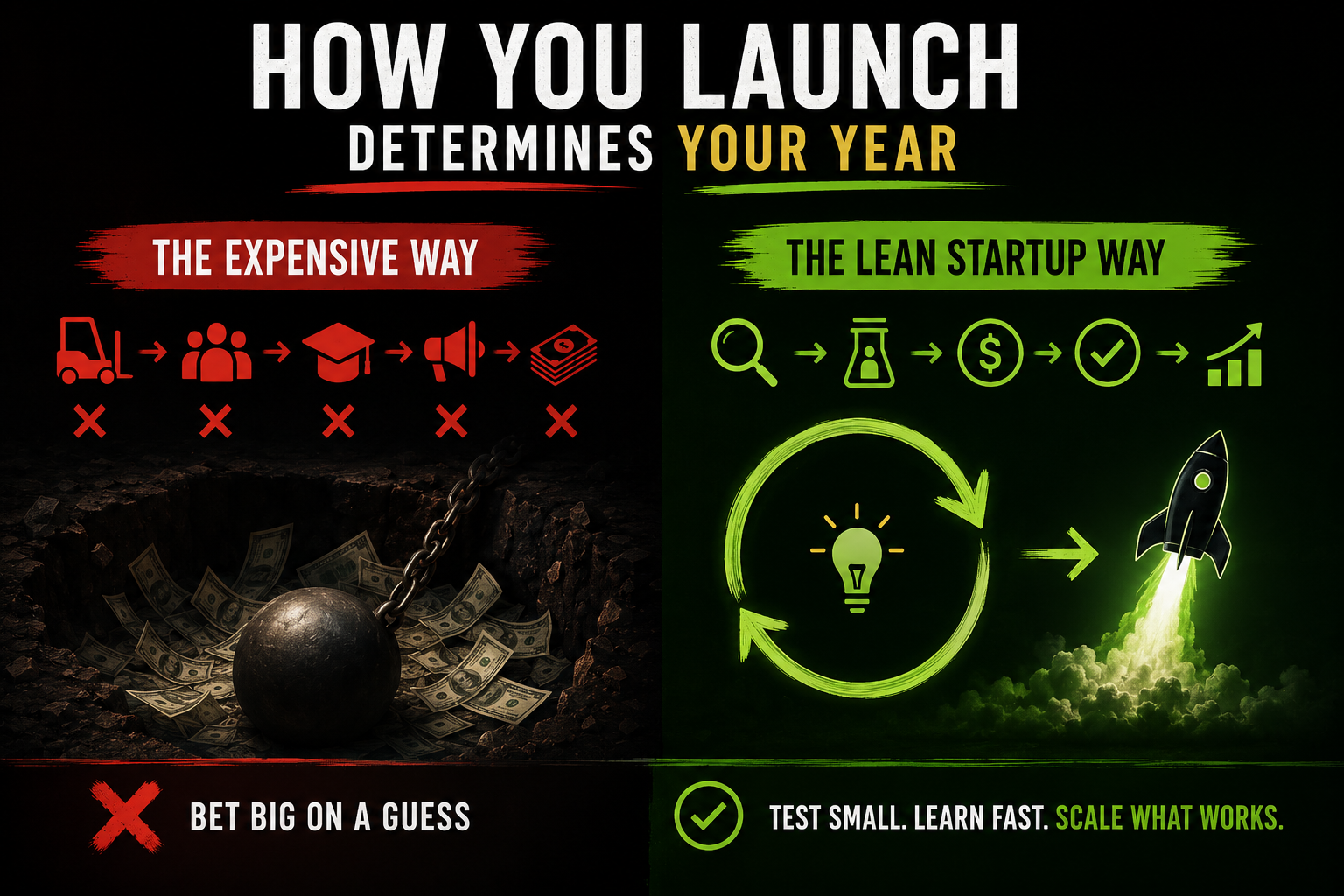
Most contractors launch a new service the expensive way: buy the equipment, hire the people, train the team, and market it, all before knowing whether customers actually want it. That’s betting a fortune on a guess. The Lean Startup approach flips it. You test the demand cheaply first, with minimal resources, measure whether real customers actually pay real money, and only then scale what proves out. Test small, learn fast, and go all-in only on what’s already working.
That’s the whole idea. Let me open it up, because how you launch a new service determines whether it grows your business or drains it.
The Expensive Way Almost Everybody Launches
Here’s how most contractors add a new service, and see if this sounds familiar.
You get an idea. Maybe you notice customers asking for something you don’t offer. Maybe you see a competitor doing it. Maybe you just think it’d be a good fit. And you get excited, so you go all-in. You buy the equipment, which isn’t cheap. You hire or train people to do the work. You get the trucks and the tools and the materials. You build out the whole operation. And then, only then, after you’ve sunk a pile of money and time into standing the whole thing up, you find out whether customers actually want it at a price that makes you money.
And a lot of the time? They don’t. The demand isn’t what you hoped. Or it is, but not at a price that’s profitable. Or it’s seasonal in a way you didn’t expect. And now you’re stuck with equipment you’re not using, people you can’t keep busy, and a hole in your bank account, all because you bet big on a guess before you had a shred of proof.
That’s the expensive way, and it’s how most new service launches fail. Not because the idea was necessarily bad, but because the contractor went all-in on an unproven assumption. They cannonballed into the deep end before checking whether there was any water in the pool. It’s the most natural thing in the world to do when you’re excited about an idea, and it’s one of the most dangerous financial mistakes a contractor can make. There’s a smarter way, and it comes from the startup world, of all places.
The Lean Startup Idea, in Plain Terms
There’s a whole methodology that came out of the tech startup world, laid out by a guy named Eric Ries in a book called The Lean Startup, and the core idea is so useful for contractors that I want to translate it plainly, because it can save you from ever making that expensive mistake again.
The whole thing is built to solve exactly the problem I just described: how do you avoid pouring a fortune into building something before you know anyone wants it? And the answer is a simple loop. Build, measure, learn. You build the smallest, cheapest version of the thing that lets you test whether people want it. You measure what actually happens when real customers encounter it. And you learn from that real data whether to keep going, change course, or kill it. Then you repeat. Instead of one giant expensive bet, you run a series of small, cheap experiments that teach you the truth before you commit big money.
The heart of it is a concept called the minimum viable product, the MVP. That’s a fancy term for the smallest, simplest version of your new offering that you can put in front of real customers to test whether they actually want it. Not the full build-out. Not the complete operation. The stripped-down, cheap-to-test version that answers the one question that matters: will real people actually pay for this? Because here’s the key insight the whole method rests on: the only proof that counts is real customers spending real money. Not people saying it sounds nice. Not your gut feeling. Not a competitor doing it. Actual paying demand. Everything in the Lean approach is designed to find out whether that real demand exists before you bet the farm on it.
So let me show you exactly how a contractor runs this play.
Test the Water Before You Dive In
The whole shift is this: before you go all-in on a new service, you test the demand cheaply first. You dip a toe in before you cannonball. And there are several low-cost ways to do exactly that, none of which require buying a single piece of equipment or hiring a single person up front.
Just offer it and see who bites. The simplest test of all. You have an existing customer base that already knows and trusts you, which is the perfect audience to gauge demand. So offer the new service to them, before you’ve built anything, and see if anyone actually wants it. Put it out there through your normal customer communication and watch the response. If you offer a new service to your warm list and the phone doesn’t ring, that’s incredibly valuable information, and it cost you nothing but a message. If it does ring, now you’ve got real interest to work with, and you’ve learned it before spending a dime on equipment. This is the cheapest market research on earth, and most contractors skip it entirely.
Deliver it with minimal resources first. Here’s the part that saves you the big upfront investment. When those first customers do say yes, you don’t need the full operation to serve them. You can deliver the new service in a minimal way to start. Use a subcontractor with the right skills instead of hiring, which is exactly what the subcontractor network I wrote about is perfect for. Rent the equipment instead of buying it. Partner with someone who already does it. Do it manually or on a small scale. The point is to fulfill that early demand using resources you can turn on and off cheaply, so you’re testing the real thing, real customers, real jobs, real money, without the massive fixed investment. You’re finding out if it works before you build the machine to do it at scale.
Run a small pilot. Instead of a full launch, run the new service small and limited, to a certain segment of customers, or in a limited area, or for a set trial period, and measure what actually happens. A small pilot gives you real market data, actual results from actual customers, without betting everything. You learn how it really sells, what customers really pay, what the real costs and challenges are, all at a small, survivable scale before you decide whether to go big.
Every one of these lets you gather real proof cheaply before you commit. That’s the entire game: learn the truth about demand while the cost of being wrong is still tiny.
Measure What Actually Matters
Testing is only useful if you measure the right things, so let’s be clear about what real proof looks like, because it’s easy to fool yourself here.
The signal that matters is real customers paying real money at a profitable price. That’s it. Not people saying “oh, that sounds great,” because talk is free and people are polite, the same lesson from measuring customer loyalty. Not a lot of interest that doesn’t convert to actual paid jobs. Not activity that feels good but doesn’t make money. The only proof that a new service is worth scaling is that actual customers are actually paying for it, at a price that actually leaves you a profit.
So when you run your test, measure the things that tell you the truth. Are people actually booking and paying for it, not just expressing interest? Are they paying a price that’s genuinely profitable for you once you account for all the real costs? Is there enough demand to be worth building out, or is it a trickle? Is there repeat demand or referral demand, signs it has legs, or was it a one-time novelty? These are the real signals. They cut through the excitement and the wishful thinking and tell you whether you’ve got something real.
This is the same stop-guessing, measure-what-matters discipline I preach on everything. It’s easy to talk yourself into a new service because you want it to work. The Lean approach forces you to let real data, real dollars from real customers, make the call instead of your hopes. Measure the money, not the enthusiasm, and you’ll know the truth.
Pivot or Persevere: The Whole Point
Now here’s where the entire method pays off, in the moment of decision after your test. You’ve run a cheap experiment, you’ve measured real results, and now you make a data-driven call. The startup world calls it “pivot or persevere,” and for a contractor it comes down to three clear paths.
If the test worked, if real customers paid real money at a profitable price and there’s genuine demand, now you scale. And notice how different this is. You’re not betting on a guess anymore. You’re investing in something that’s already proven to work. Now you buy the equipment, hire the people, build the operation, with confidence, because the demand is real and you’ve seen it with your own eyes. The big investment finally makes sense because the risk is gone. That’s persevering, and it’s how you grow smart.
If the test showed promise but something was off, maybe the demand was there but the price didn’t work, or the delivery had problems, you adjust and test again. You change the thing that was broken and run another small experiment. That’s pivoting, and it costs you almost nothing because you never over-committed. You’re refining toward something that works, cheaply, before you scale.
And if the test flopped, if there just wasn’t profitable demand, you kill it. And here’s the beautiful part: killing it barely hurt, because you never went all-in. You spent a little to run a small test, you learned the idea didn’t work, and you walked away having lost almost nothing. Compare that to the contractor who went all-in on the same idea and lost a fortune finding out the same thing. You both learned the exact same lesson. One of you paid a fortune for it and one of you paid almost nothing. That’s the whole value of the method right there.
This is the mindset shift that changes everything: you run experiments, not bets. A bet is all-in on a guess, and when it’s wrong it’s a catastrophe. An experiment is a small, cheap test designed to teach you something, and when it “fails” it succeeds, because it taught you the truth cheaply and saved you from the catastrophe. Failure becomes cheap and educational instead of expensive and fatal. That’s how you innovate and add services without risking the business every time you try something new.
Why This Matters More Than Ever
Let me make the case for why every contractor should run their business this way when it comes to new services, because it’s not just about avoiding losses, it’s about being able to grow safely.
The contractor who launches new services the expensive way can only afford to be wrong a few times before it sinks them. Every new service is a huge bet, so they either avoid trying new things entirely, which means they stagnate, or they take big swings and eventually one of the misses wipes out the gains. Either way, growth is dangerous for them, because their method makes every experiment a bet-the-business moment.
The contractor who runs lean can try lots of things safely. Because each test is small and cheap, they can experiment often, learn constantly, and let the winners reveal themselves through real data. They kill the losers cheaply and scale the winners confidently. Over time, that contractor discovers more good new services, avoids more expensive flops, and grows faster and safer than the one making big guesses. Testing small doesn’t just protect you from losses, it frees you to innovate, because when being wrong is cheap, you can afford to try. That’s a massive competitive advantage, and it comes entirely from changing how you launch instead of what you launch.
How to Roll This Out Starting Monday
Same rhythm as always. One step at a time, applied to whatever new service you’re considering.
Week one: test demand with your existing customers. Before building anything, offer the new service to your warm customer base and measure the real response. Do people actually want to book it, or is it crickets? This is the cheapest, fastest demand test there is, so start here and let the response guide you.
Week two: deliver early demand with minimal resources. For the customers who say yes, fulfill the service using resources you can turn on and off cheaply, a sub, rented equipment, a partner, or a manual approach, instead of buying the full setup. Test the real thing with real customers without the big fixed investment.
Week three: run a small pilot and measure the real signals. Run the service small and limited, and measure what actually matters, real paid jobs, a profitable price, real demand levels, and signs of repeat or referral interest. Let the actual dollars, not your excitement, tell you the truth.
Week four: pivot, persevere, or kill it. Make the data-driven call. Scale confidently if it proved out, adjust and re-test if it showed promise with a problem, or kill it cheaply if the demand wasn’t there. Then apply the same lean approach to the next idea. Make testing before building your permanent habit.
Four weeks to replace expensive guessing with cheap learning. Do this every time you consider a new service, and you’ll add the winners, avoid the losers, and grow your business without betting it every time you try something new.
Frequently Asked Questions
Why is launching a new service the traditional way so risky? Because you invest heavily, buying equipment, hiring, training, and marketing, before you have any proof customers actually want it at a profitable price. If the demand isn’t there, you’re stuck with unused equipment, idle staff, and a big financial hole. You bet a fortune on a guess. The smarter approach tests demand cheaply first and only invests big once the demand is proven.
What is a minimum viable product for a contractor? It’s the smallest, cheapest version of a new service you can put in front of real customers to test whether they’ll actually pay for it, without building the full operation. Instead of buying equipment and hiring, you might offer it to existing customers, deliver early jobs with a subcontractor or rented equipment, or run a small pilot. The goal is real proof of demand at minimal cost.
How do I test demand for a new service cheaply? Start by offering it to your existing customer base, who already trust you, and measure whether they actually book it. For early customers who say yes, deliver the service using minimal, flexible resources like subcontractors or rented equipment instead of a full build-out. And run a small, limited pilot to gather real market data before committing to a full launch.
What signals tell me a new service is worth scaling? Real customers paying real money at a profitable price, not just people saying it sounds nice. Measure whether people actually book and pay, whether the price leaves you a genuine profit, whether demand is strong enough to be worth building out, and whether there’s repeat or referral demand showing it has legs. Actual paid demand is the only proof that counts.
What do I do if my test shows the new service isn’t working? You either adjust and test again if it showed promise with a fixable problem, like a price issue, or you kill it if there just wasn’t profitable demand. Because you tested small and cheap, killing it barely costs you anything, unlike going all-in and losing a fortune to learn the same lesson. A failed cheap test is a success, because it saved you from an expensive disaster.
The Bottom Line
The most dangerous way to grow your business is to launch new services the expensive way, buying everything and building everything before you know anyone wants it. That’s betting a fortune on a guess, and it’s how good contractors blow holes in their finances chasing ideas that never had real demand.
The Lean approach fixes it. Test the water before you dive in. Offer the service to your existing customers and measure the response. Deliver early demand cheaply with subs or rented gear. Run a small pilot. Measure real paid demand, not enthusiasm. And then make a clear call: scale what proves out, adjust what shows promise, and kill what doesn’t, cheaply, before it can hurt you.
Run experiments, not bets. When being wrong costs you a little instead of everything, you’re free to try new things constantly, discover the winners, and grow faster and safer than the contractor swinging for the fences on guesses. Stop guessing. Start testing. That’s how you innovate without risking the business you built.
If you want help thinking through which new services to test and how to grow your business without betting it on unproven ideas, that’s the work we do with contractors every day. Book a free strategy session and let’s test your next move.
Josh Kelly is Co-Founder of Clover Growth Partners, where he helps home service contractors build businesses that grow without depending on them being in every truck.