
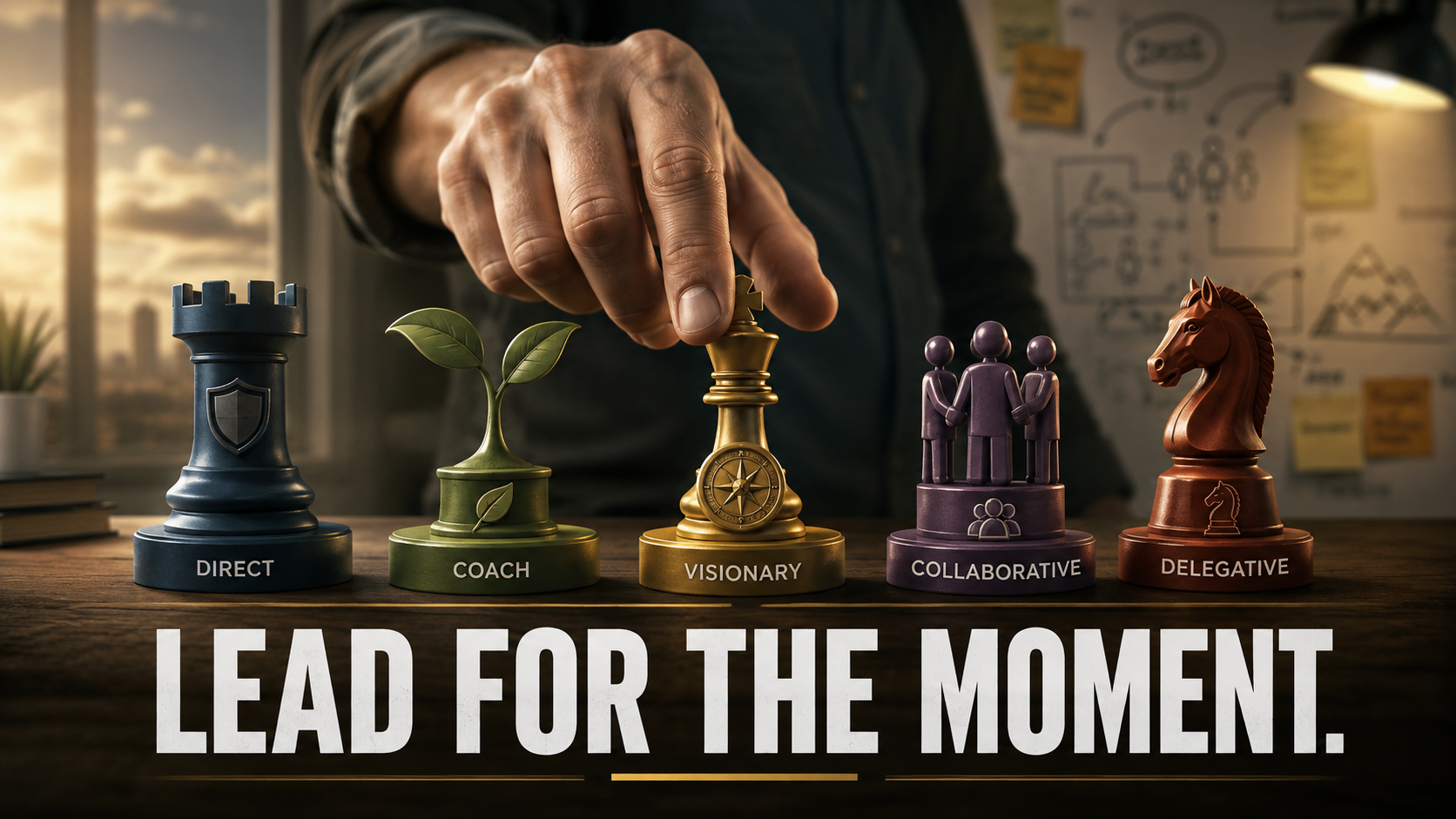
There’s no single right way to lead. The best leaders adapt their style to the person and the situation in front of them. There are five core styles, directive, coaching, supportive, delegative, and transformational, and each fits different people and different moments. The real skill isn’t picking one and using it on everyone. It’s reading what a specific person needs from you right now and choosing the style that fits, instead of defaulting to your one comfortable style whether it works or not.
That’s the whole idea. Let me open it up, because leading everyone the same way is why a lot of good contractors struggle to get the best out of their teams.
The One-Style Trap
Here’s how most people lead, contractors included, and it’s the root of a lot of team frustration.
Most leaders have one default style, the way they naturally lead, and they use it on everyone in every situation. Maybe you’re a directive type, the “here’s exactly what to do, now go do it” leader who takes charge and gives orders. Maybe you’re a hands-off delegator who hands things off and gets out of the way. Maybe you’re a supportive encourager who’s all about backing people up. Whatever your natural style is, you probably apply it to everybody, all the time, because it’s how you’re wired and it’s comfortable.
And here’s the problem with that. Different people need different things from you, and different situations call for different approaches. Your one style works great with some people and some situations, the ones it happens to fit, and it fails badly with others. The directive leader who barks orders gets great results in a crisis but crushes and frustrates his experienced veterans who don’t need to be told every step. The hands-off delegator empowers his top performers beautifully but leaves his new hires floundering with no guidance. The one-size-fits-all approach guarantees inconsistent results, because you’re using the same tool for every job, and no single tool is right for every job.
Think about it in terms you know. If the only tool in your toolbox was a hammer, you’d do great on anything that needs a hammer, and you’d make a mess of everything that needs a wrench or a screwdriver. A leader with only one style is a contractor with only a hammer, swinging it at every problem whether it’s a nail or not. The best leaders don’t have one tool, they have a full toolbox of leadership styles, and they know which one to reach for in each situation. Let me walk you through the five tools, then how to know which to grab.
Style One: Directive
The first style is directive, where you give clear, specific direction, telling people exactly what to do and how to do it. You take charge, make the calls, and provide clear instruction and structure.
When is directive the right tool? It’s best for a few specific situations. New or inexperienced people who genuinely need guidance, they don’t yet know how to do the work, so clear direction helps them rather than frustrates them. Crisis or urgent situations that need decisive, immediate direction, when something’s on fire, people need someone to take charge and say “here’s what we do,” not a group discussion. And any situation where clarity and speed matter most, where clear, specific instruction is exactly what’s needed to get it done right and fast.
When is directive the wrong tool? With experienced, capable people who know what they’re doing, being directive comes across as micromanaging and it frustrates and demoralizes them. Telling a skilled veteran every step of a job they’ve done a thousand times insults them and kills their engagement. So directive is powerful when someone needs direction, and damaging when they don’t. Reach for it with the new, the uncertain, and the urgent, and put it away with your experienced, capable people who need room, not orders.
Style Two: Coaching
The second style is coaching, where you teach, develop, and guide, helping people grow their skills and capability. You’re more involved than just giving orders, but your focus is on developing the person, not just directing the task. You ask questions, teach, explain the why, and help them learn.
When is coaching the right tool? It’s best for people who are developing and learning, who have some motivation but aren’t yet fully skilled. The person who’s eager and trying but still building their capability, coaching helps them grow into competence. It’s the tool for building your people’s skills over time, for the employee you’re developing toward being able to work more independently. Coaching is an investment in the person, teaching them to fish rather than just handing them a fish, and it’s how you grow capable, independent team members.
Coaching takes more time and involvement than the other styles, which is why it’s not always the right tool, in a crisis you don’t have time to coach, you direct. But when you’re building capability and developing your people, coaching is exactly right. It’s the developmental style, focused on growing the person for the long term. Use it when your goal is to make someone better, not just to get a task done, and it pays off as they grow into people who need far less of your direction over time.
Style Three: Supportive
The third style is supportive, where you encourage, listen, back people up, and build their confidence and morale. You’re focused less on the task and more on the person’s emotional state, providing support, encouragement, and a listening ear.
When is supportive the right tool? It’s best when the issue is confidence or motivation rather than skill. A capable person who’s struggling with their confidence, who has the ability but is doubting themselves, needs your support and encouragement, not more instruction. Someone going through a hard time, personally or professionally, needs you to back them up and listen. When a good employee is in a slump, discouraged, or shaken, the supportive style, encouragement, belief in them, a listening ear, is what helps them through it. The problem there isn’t that they don’t know how, it’s their will or morale, and support addresses that.
The key is recognizing when someone needs support versus direction. If you respond to a confidence problem with more directive instruction, you miss what they actually need and can make it worse. If you recognize that a capable person is struggling with morale, not skill, and you provide genuine support and encouragement, you help them recover and get back to their best. Supportive leadership is how you care for your people through the rough patches and rebuild their confidence, and a leader who can do that earns deep loyalty. Reach for it when the issue is heart, not skill.
Style Four: Delegative
The fourth style is delegative, where you hand things off, trust people to run with them, and get out of the way. You empower capable people to take ownership and operate independently, with minimal involvement from you.
When is delegative the right tool? It’s best with your skilled, experienced, self-motivated people, the ones who know what they’re doing and don’t need your direction, your veterans and top performers. For these people, the best thing you can do is trust them, empower them, and get out of their way, giving them ownership and autonomy. Delegating to capable, motivated people frees them to do their best work, shows them you trust them, and frees you up too. It’s the right tool for the people who’ve earned it and are ready for it, and it’s how you develop and retain your best people, who want autonomy, not oversight.
When is delegative the wrong tool? With people who aren’t ready for it, who lack the skill or the self-direction to run independently, delegating leaves them floundering without the guidance they need. Hand a complex job to a brand-new hire with no direction and they’ll struggle and fail, and it’s your fault for using the wrong tool. So delegative is powerful with the ready and damaging with the not-yet-ready. Reach for it with your capable, proven people, and hold off with those who still need direction or coaching first. Match the autonomy to the readiness.
Style Five: Transformational
The fifth style is transformational, where you inspire, cast vision, and lead people toward a bigger purpose and their best selves. You elevate the whole team’s sights, connecting their work to a meaningful mission and inspiring them to rise to it. This is the big-picture, inspiring style that lifts everyone.
When is transformational the right tool? It’s best for rallying the team around a vision or mission, for driving big change, and for inspiring and elevating everyone toward something bigger than the daily grind. When you want to energize the whole team, create genuine buy-in, and lift people’s sights beyond just getting through the day, transformational leadership does it. It’s how you build a team that’s inspired and bought into a real purpose, not just showing up for a paycheck. Used across your whole team, it creates energy, meaning, and commitment that the other, more individual styles don’t.
Transformational leadership is a bit different from the others, which are mostly about how you handle a specific person in a specific moment. This one is more about how you inspire and elevate the whole team over time, connecting them to vision and purpose. The best leaders use it to create a team that’s genuinely inspired and committed, which makes every other part of leading easier. So while you’re matching directive, coaching, supportive, and delegative to individuals and situations, you’re also using transformational leadership to lift the whole team toward a bigger purpose. It’s the style that creates the inspired, committed culture the others operate within.
Reading What’s Needed
Here’s the real skill that makes all five styles work: reading what a specific person needs in a specific moment, so you can pick the right one. Having the tools isn’t enough, you have to diagnose which tool the situation calls for. And there’s a simple way to read it.
Look at two things about the person and the task. First, their competence, do they actually have the skill to do this? Do they know how? Second, their confidence and motivation, are they willing, confident, and motivated to do it? Those two variables tell you a lot about which style fits. Someone new who lacks the skill but is eager needs direction and coaching, so you teach and guide. Someone skilled but shaky on confidence needs support, so you encourage and back them up. Someone both skilled and motivated needs delegation, so you empower them and get out of the way. Reading where a person is on skill and will points you to the right style for them right now.
And read the situation too, not just the person. A crisis calls for directive leadership regardless of who’s involved, because urgency needs decisive direction. A moment of big change or a need to energize the team calls for transformational leadership. The same person might need different styles from you in different moments, directive in a crisis, delegative on a routine job they’ve mastered, supportive when they’re going through something hard. So you’re reading both the person’s skill and will and the demands of the situation, and then choosing the style that fits. That reading, that diagnosis, is the heart of versatile leadership. Grab the right club for the shot in front of you.
The Self-Awareness to Break Your Default
Here’s the hardest part, and the one that separates leaders who are truly versatile from those who just think they are: self-awareness about your own default, and the discipline to break it when it doesn’t fit.
Everyone has a default style, the one they naturally reach for, the one that’s comfortable. And the trap is that under pressure, or just out of habit, you unconsciously default to your comfortable style even when the situation calls for a different one. The natural director directs everyone, including the veterans who need delegation. The natural delegator delegates to everyone, including the new hires who need direction. You reach for your hammer out of habit, whether or not the job is a nail. And you often don’t even notice you’re doing it, which is why so many leaders think they’re adaptable when they’re really just applying their one default everywhere.
So the crucial skill is self-awareness. Know your own default style, honestly. Then learn to catch yourself reaching for it out of habit, and deliberately pause to ask what style this person and this situation actually need, and choose that one, even when it’s not your comfortable one. That deliberate choice, overriding your default to use the style that actually fits, is what makes you genuinely versatile rather than just a one-style leader who thinks they adapt. It takes real self-awareness and real discipline, because your default will always be pulling at you. But a leader who knows their default and can consciously override it to give each person and situation what it actually needs gets dramatically better results than one running on autopilot with a single style. Know your hammer habit, and reach for the right tool on purpose.
How to Roll This Out Starting Monday
Same rhythm as always. One step at a time.
Step one: identify your default style. Honestly figure out which of the five styles is your natural default, the one you reach for automatically. You can’t override a default you haven’t identified, so start with honest self-awareness about how you naturally lead and where that default fits well and where it doesn’t.
Step two: learn the five tools. Get familiar with all five styles, directive, coaching, supportive, delegative, and transformational, and when each is the right tool. Build out your full leadership toolbox so you have every style available, not just your comfortable one.
Step three: practice reading what’s needed. Start diagnosing what your people and situations actually need by reading each person’s skill and confidence and the demands of the moment. New and eager needs direction and coaching, skilled but shaky needs support, skilled and motivated needs delegation, crisis needs direction, big change needs vision. Read, then pick the fitting style.
Step four: catch and override your default. Build the discipline to catch yourself reaching for your default out of habit, pause, and deliberately choose the style the situation actually calls for. And use transformational leadership across your whole team to lift everyone toward a bigger purpose. Lead each person the way they need, not the way that’s comfortable for you.
Four steps to go from a one-style leader to a versatile one who gets the best out of every different person, by matching the right leadership tool to the right person and moment.
Frequently Asked Questions
What are the five leadership styles? Directive, where you give clear, specific instruction; coaching, where you teach and develop people’s skills; supportive, where you encourage and build confidence; delegative, where you empower capable people and get out of the way; and transformational, where you inspire and rally the team around a bigger purpose. Each fits different people and situations, and the best leaders use all five rather than defaulting to just one.
Is there a single best leadership style? No. There’s no single right way to lead, because different people and situations need different things from you. The best leaders are versatile, matching their style to the person and the moment, like a contractor choosing the right tool for each job. A leader with only one style does great where it fits and poorly everywhere else, which is why versatility across all five styles produces far better and more consistent results.
How do I know which leadership style to use? Read two things about the person, their competence (do they have the skill?) and their confidence or motivation (are they willing and confident?). New but eager needs direction and coaching, skilled but shaky needs support, skilled and motivated needs delegation. Also read the situation: a crisis needs directive leadership, and driving big change or energizing the team needs transformational. Then choose the style that fits the person and moment.
Why is using one leadership style on everyone a problem? Because different people and situations need different things, so one style works great where it fits and fails where it doesn’t. A directive leader crushes his experienced veterans who need autonomy; a hands-off delegator leaves new hires floundering without guidance. Using the same approach on everyone guarantees inconsistent results, like using a hammer for every job. Matching your style to each person’s needs is what gets the best from everyone.
What’s the hardest part of adapting my leadership style? Self-awareness and the discipline to break your own default. Everyone naturally reaches for one comfortable style, often unconsciously, even when the situation calls for a different one, so many leaders think they adapt when they really just apply one default everywhere. The hard skill is knowing your default, catching yourself reaching for it out of habit, and deliberately choosing the style the person and situation actually need instead.
The Bottom Line
There’s no single right way to lead, and the leaders who get the best out of their teams know it. Different people need different things from you, and different situations call for different approaches, so leading everyone the same way guarantees you’ll do great with some and poorly with others.
The answer is a full toolbox. Learn all five styles, directive for the new and the urgent, coaching to develop and grow people, supportive to rebuild confidence and morale, delegative to empower your capable proven people, and transformational to inspire and elevate the whole team. Then read what each person and situation actually needs, their skill, their confidence, the demands of the moment, and choose the style that fits. And above all, know your own default and build the discipline to override it, so you lead each person the way they need rather than the way that’s comfortable for you.
A contractor with only a hammer makes a mess of every job that isn’t a nail. A leader with only one style does the same to their team. Build the full toolbox, read what’s needed, break your default, and reach for the right tool every time. That’s how you get the best out of every single person on your team.
If you want help developing the versatile leadership that gets the best out of your whole team, that’s the work we do with contractors every day. Book a free strategy session and let’s build your leadership.
Josh Kelly is Co-Founder of Clover Growth Partners, where he helps home service contractors build businesses that grow without depending on them being in every truck.