
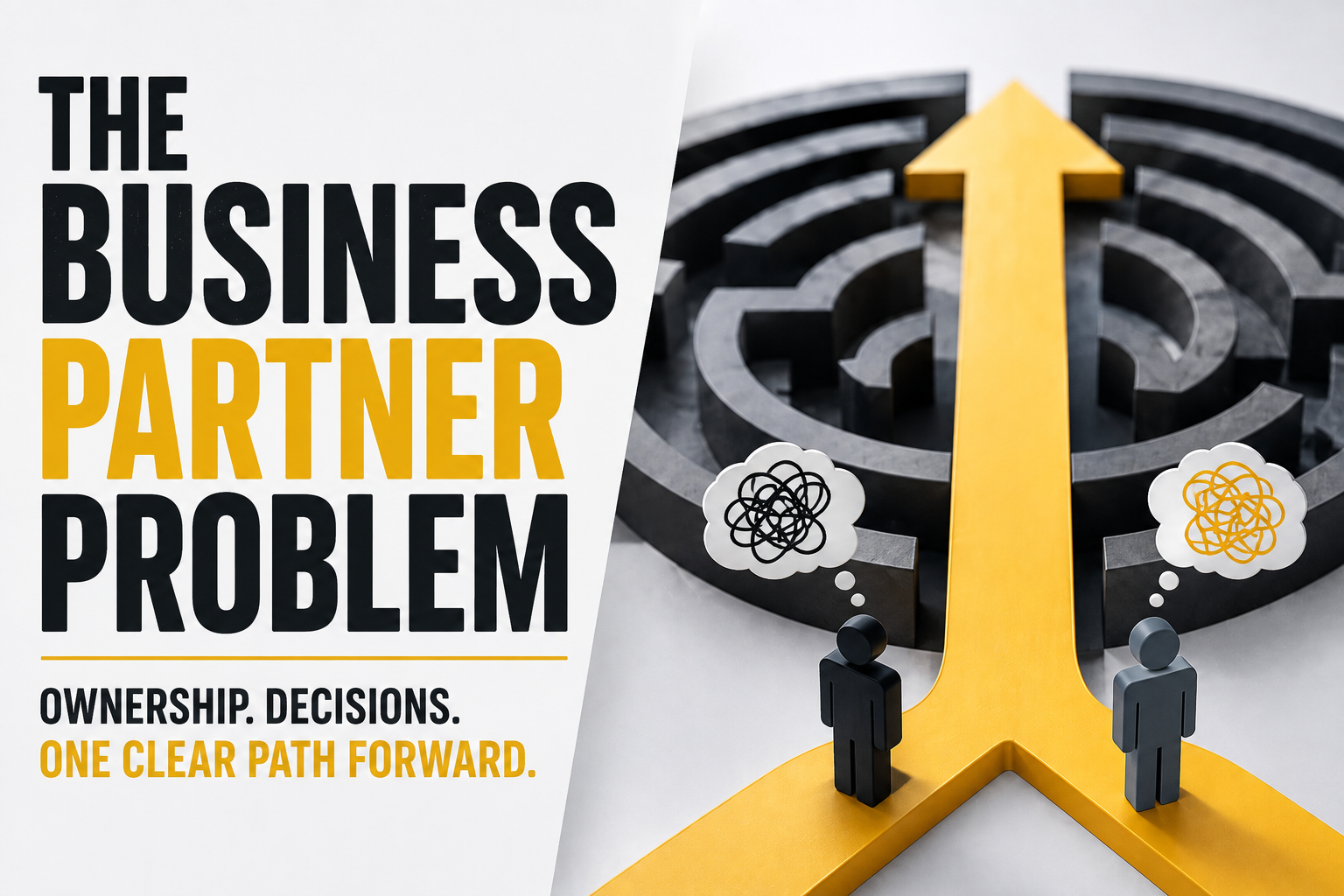
Most business partnerships don’t fail because the partners stop liking each other. They fail because two people started a business together and never had the hard structural conversations. Who decides what. How you break a tie. How the money splits when the effort isn’t equal. What happens if someone wants out. Have those conversations early, put them in writing, and you protect both the business and the friendship.
That’s the whole thing. Let me open it up, because this one wrecks more good businesses than almost anything else.
Why Good Partnerships Blow Up
Let me tell you how it usually goes, and see if any of it sounds familiar.
Two people who trust each other decide to go into business together. Maybe they were buddies. Maybe they worked together and figured they’d be stronger as a team. They’re excited, the energy’s good, and the last thing on their mind is sitting down to hammer out what happens if things get hard. That feels negative. It feels like you’re planning for failure before you’ve even started. So they skip it. They shake hands, maybe split it fifty-fifty because that feels fair, and they get to work.
And for a while it’s great. Both partners are grinding, the business is growing, everybody’s pulling in the same direction. Nobody needs an agreement when things are good, right? Everybody’s happy.
Then something shifts. One partner starts feeling like they’re working harder than the other. Or they disagree on a big decision and there’s no way to break the tie, so it just festers. Or the money gets bigger and suddenly how it splits actually matters. Or one person’s life changes, a divorce, a health scare, a new priority, and they want out, and nobody ever decided how that would work. And now these two people who trusted each other completely are staring at each other across a table with no rules, no structure, and a whole lot of resentment, trying to untangle a mess they could have prevented with a few conversations at the start.
Here’s the truth. The friendship didn’t cause the failure. The silence did. All the stuff they didn’t talk about, sitting there quietly like a debt, until the day it all came due at once.
The Agreement Is How You Protect the Friendship
I want to flip how you think about this, because the reframe changes everything.
Most people avoid the structural conversations because they think an agreement is about distrust. Like asking for it out loud says “I don’t trust you.” So they skip it to protect the relationship. And that’s exactly backwards.
The agreement isn’t what threatens the friendship. The agreement is what protects it. Think about it. The reason partnerships turn ugly is that undefined situations force two people to fight it out with no rules, and fighting with no rules is how relationships die. A clear agreement means that when the hard stuff comes, and it will come, you don’t have to fight about it. You already decided, back when you liked each other, back when you were thinking clearly instead of emotionally. The rules do the hard work so the friendship doesn’t have to.
The best time to write these rules is right now, when you like each other and nothing’s on fire. When two partners sit down calm and clear-headed and decide how they’ll handle money and disagreements and exits, they’re being generous to their future selves. They’re taking the hardest conversations and having them at the easiest possible moment. You do not want to be figuring out your deadlock process in the middle of an actual deadlock. That’s like trying to check whether the boat has life jackets after you’re already in the water.
So drop the idea that the agreement is an insult. It’s the opposite. It’s two people who respect each other enough to make sure a hard day never turns them into enemies. That’s not distrust. That’s care.
Now let me walk you through the conversations you actually need to have.
Conversation One: Who Actually Decides What
The first mistake most partnerships make is thinking equal ownership means equal say on everything. Fifty-fifty feels fair, so they run the whole business by committee, both weighing in on every decision.
That sounds nice and it’s a disaster. When two people have to agree on everything, you get one of two outcomes. Either you move at a crawl because nothing happens without a debate, or you deadlock and nothing happens at all. Two people in one kayak, both paddling hard, but pulling in different directions. All that effort and you just spin in circles.
The fix is to divide the domains. Even if you own the business fifty-fifty, you don’t have to decide everything fifty-fifty. Figure out who’s better at what and give that person clear authority over that area. Maybe one partner runs operations, the field, the crews, the day-to-day. The other runs sales, marketing, and the money. In their domain, that person decides, and the other partner trusts them to decide. You’re not asking permission from each other on every little thing. You each own your lane and drive it.
This does two things. It kills the slow, committee-driven paralysis that strangles so many partnerships, and it plays to each person’s strengths instead of forcing both of you to be mediocre at everything. The business gets faster and sharper, and you both stop feeling like you need a hall pass to do your job.
You’ll still have the big decisions you make together, the ones that affect the whole company. That’s coming in a second. But the daily and weekly stuff, the vast majority of decisions, should have one clear owner. Clarity on who decides what is the foundation everything else sits on.
Conversation Two: How You Break a Tie
Okay, so you divided the domains, but there are still big decisions you have to make together. Taking on debt. A major hire. Buying a building. Changing direction. The company-level stuff where you both need to weigh in.
And here’s the deadly question nobody wants to ask. What happens when you can’t agree?
This is the fifty-fifty trap that kills partnerships. Two equal owners, a big decision, and a genuine disagreement. Neither can overrule the other. So you’re stuck. The decision doesn’t get made, the resentment builds, and the business stalls at the exact moment it needed a call. A tie with no tiebreaker is a slow-motion catastrophe.
You have to decide the tiebreaker before you need it. There are a few ways partners handle this, and there’s no single right answer, only the answer you both agree to in advance. Some partnerships give one partner a slight majority, fifty-one to forty-nine, specifically so somebody can break a tie on the rare deadlock. Some split ownership evenly but name specific decision areas where each partner has the final call. Some agree to bring in a neutral third party, a trusted advisor or a board, to break true deadlocks. Some write in a cooling-off process, where a deadlock triggers a mandatory wait and a structured conversation before anyone forces it.
The specific mechanism matters less than the fact that you have one. What you cannot do is leave it undefined and hope you’ll always agree, because the one time you don’t, with no way to break it, is the time the whole thing can come apart. Decide your tiebreaker now, while it’s hypothetical and calm, so it’s ready when it’s real and hot.
Conversation Three: The Money and the Resentment It Breeds
Money is where partnerships quietly rot, and it almost always traces back to one feeling. Resentment. The sense that the split isn’t matching the effort.
Here’s how it builds. Two partners own the business fifty-fifty. At the start, they’re both grinding equally, so an even split of the money feels right. But over time, things drift. Maybe one partner is putting in seventy hours and the other is coasting at forty. Maybe one is bringing in all the sales and the other is just running the shop. The effort stops being equal, but the money’s still splitting down the middle, and the harder-working partner starts doing math in their head at two in the morning. That math is where partnerships go to die.
So you have to separate two things that get tangled together. There’s ownership, which is what percentage of the business each person owns. And there’s compensation, which is what each person gets paid for the work they actually do. These are not the same thing, and treating them like they are is a huge source of resentment.
The cleaner way is to pay each partner a fair salary for the actual role they play, the work they actually do, before you ever split the profits. The operations partner gets paid a market wage for running operations. The sales partner gets paid for running sales. Then, after everyone’s paid fairly for their work, the leftover profit gets split according to ownership. That way, if one partner works more or brings more to the table, they’re compensated for that work directly, and the ownership split stays clean and separate. Nobody’s subsidizing anybody. Nobody’s doing resentful math at 2am.
You also need to decide, together and in advance, what happens to the profit. How much you reinvest in the business versus how much you each take home. Partners with different appetites for risk and different personal money needs can clash hard on this if they never talked about it. One wants to plow everything back into growth, the other needs to take money home to cover their life. Neither is wrong. But you have to align on it on purpose, or it becomes another quiet source of friction.
Conversation Four: The Exit Nobody Wants to Talk About
This is the conversation people avoid the hardest, and it’s the one that turns into a legal war when it’s skipped. What happens when a partner leaves?
And a partner will leave eventually. Every partnership ends somehow. Someone wants to retire. Someone wants to cash out and do something else. Someone gets divorced and their spouse suddenly has a claim on their share. Someone gets sick. Someone dies, and now you’re in business with their heirs, who know nothing about the business and just want money. These aren’t dark hypotheticals. They’re the normal life events that eventually hit every partnership, and if you haven’t planned for them, they become catastrophes.
This is what a buy-sell agreement is for, and it’s the single most important document most partners never bother to create. It answers the hard questions before they’re emotional. If a partner wants out, how do they get out, and how is their share valued and paid for? If a partner dies or becomes disabled, what happens to their ownership, and can the remaining partner buy it out instead of ending up in business with the estate? What stops a partner from selling their share to some stranger you’d never want as a partner? How do you value the business fairly when nobody’s in a mood to be fair?
You decide all of that now, while everyone’s healthy and friendly and thinking clearly. You agree on how a departing partner gets bought out, how the price gets set, how it gets funded. You put it in writing. And then, if the day ever comes, you’re not fighting over a dead partner’s shares with their grieving family or untangling a mess in the middle of a divorce. The rules are already there, decided by two people who cared about each other and about being fair.
I know it’s uncomfortable to sit down and talk about death and divorce and someone wanting out, especially when you’re excited and things are good. Do it anyway. It’s the most important conversation on this whole list, and it’s the one that saves the most pain.
Get a Real Attorney to Paper This
Let me be straight with you about something, because it matters.
I’m not a lawyer, and none of this is legal advice. What I’ve given you are the conversations you need to have and the thinking behind them, so you walk into this with your eyes open instead of shaking hands on a vibe. But the actual agreement, the operating agreement, the buy-sell, the ownership structure, all of it needs to be papered by a real business attorney in your state, and reviewed by a good accountant for the tax and money side.
This is not the place to save a few bucks with a template off the internet. A proper partnership agreement, done right by a professional who does this for a living, is one of the cheapest forms of insurance you’ll ever buy against one of the most expensive disasters you can face. The cost of getting it done properly is a rounding error next to the cost of a partnership war with no rules. Have the conversations yourselves, get aligned, then bring in the pros to make it real and binding. Do both.
Partnerships Need Maintenance, Not Just a Contract
One last thing, because the agreement alone isn’t enough. A partnership is a living relationship, and like any relationship, it needs ongoing communication, not just a document you sign once and file away.
The best partnerships have a rhythm. Regular partner meetings, separate from the daily operational stuff, where the two of you step back and talk honestly. How’s the business doing against the plan? How are we each feeling about our roles, our effort, the money? Is anything building up that we should air out before it becomes resentment? Are we still aligned on where this is going?
That last one matters more than people think. Partners drift in what they want. One starts dreaming of scaling to ten locations while the other just wants a comfortable, profitable lifestyle business. Neither is wrong, but if you don’t check in on it, you wake up one day pulling in completely different directions and wondering when your partner changed. They didn’t change on you. You just stopped talking about the destination.
Small, honest conversations, held regularly, keep the little resentments from compounding into big ones. It’s the gym again. One conversation changes nothing. A steady rhythm of honest check-ins over years keeps the whole partnership strong. Talk early, talk often, and nothing festers long enough to blow up.
How to Roll This Out Starting This Week
If you’re already in a partnership without this structure, or you’re about to start one, here’s the move. One conversation at a time. Don’t try to solve all of it in a single tense marathon meeting.
Week one: roles and authority. Sit down and divide the domains. Who owns operations, who owns sales and money, who decides what. Get clarity on your lanes so you stop running everything by committee.
Week two: deadlock and money. Decide your tiebreaker for the big shared decisions, and separate ownership from compensation so each of you is paid fairly for the actual work before profits split. Talk through reinvestment versus taking money home.
Week three: the exit. Have the uncomfortable buy-sell conversation. What happens if someone wants out, dies, gets divorced, or gets an offer to sell. Decide how a departing partner gets valued and bought out, while everyone’s healthy and friendly.
Week four: make it real. Take everything you’ve aligned on to a business attorney and an accountant. Get the operating agreement and buy-sell properly drafted and signed. Then set up your regular partner meeting rhythm so the relationship keeps getting maintained, not just documented.
Four conversations, one document, and a rhythm of honest check-ins. That’s the difference between a partnership that makes both of you rich and one that ends in a courtroom with two people who used to be friends.
Frequently Asked Questions
Why do so many business partnerships fail? Not because the partners stop liking each other, but because they never had the structural conversations at the start. Undefined roles, no tiebreaker for disagreements, money splits that stop matching the effort, and no plan for someone leaving all pile up quietly until they explode at once. The silence causes the failure, not the friendship.
Should partners always split ownership fifty-fifty? Even fifty-fifty ownership shouldn’t mean fifty-fifty say on every decision. Divide authority by domain so each partner owns their lane and the business doesn’t stall in committee. And for shared big decisions, you need a defined tiebreaker, because a true fifty-fifty deadlock with no way to break it is one of the most common partnership killers.
How do I keep money from creating resentment between partners? Separate ownership from compensation. Pay each partner a fair market salary for the actual work they do before you split any profits, so a harder-working partner is compensated for that work directly. Then split leftover profit by ownership. Also agree in advance on how much to reinvest versus take home, since partners often differ on that.
What is a buy-sell agreement and do I really need one? It’s the document that decides in advance what happens when a partner exits, whether by choice, death, disability, or divorce. It sets how a departing partner’s share is valued, funded, and bought out, and prevents you from ending up in business with a stranger or an estate. It’s the most important partnership document most partners never create, and yes, you need it.
Can’t I just use an online template for our partnership agreement? No. Have the conversations yourselves to get aligned, but the actual agreement needs a real business attorney in your state and a good accountant for the tax side. A properly drafted agreement is cheap insurance against an extremely expensive disaster. This is not the place to cut corners with a generic template.
The Bottom Line
Partnerships don’t have to be a gamble. The reason so many good ones end in disaster is that two people who trusted each other skipped the hard conversations, and the silence eventually came due with interest. You can choose differently.
Have the conversations now, while you like each other and nothing’s on fire. Define who decides what. Agree on how you’ll break a tie. Separate ownership from pay so effort and money stay fair. Plan the exit before anyone needs it. Get it all papered by real professionals. And then keep talking, regularly and honestly, so nothing festers.
Two people in a kayak can go incredibly far, faster and stronger than one, but only if they’re paddling in the same direction and they agreed on where they’re going before they pushed off from shore. Have the conversations. Protect the friendship. Build the thing right.
If you want help thinking through the structure, roles, and systems that make a partnership actually work, that’s the kind of thing we help contractors navigate every day. Book a free strategy session and let’s talk it through.
Josh Kelly is Co-Founder of Clover Growth Partners, where he helps home service contractors build businesses that grow without depending on them being in every truck. This article is general information, not legal or financial advice. Consult a qualified attorney and accountant for your specific situation.