
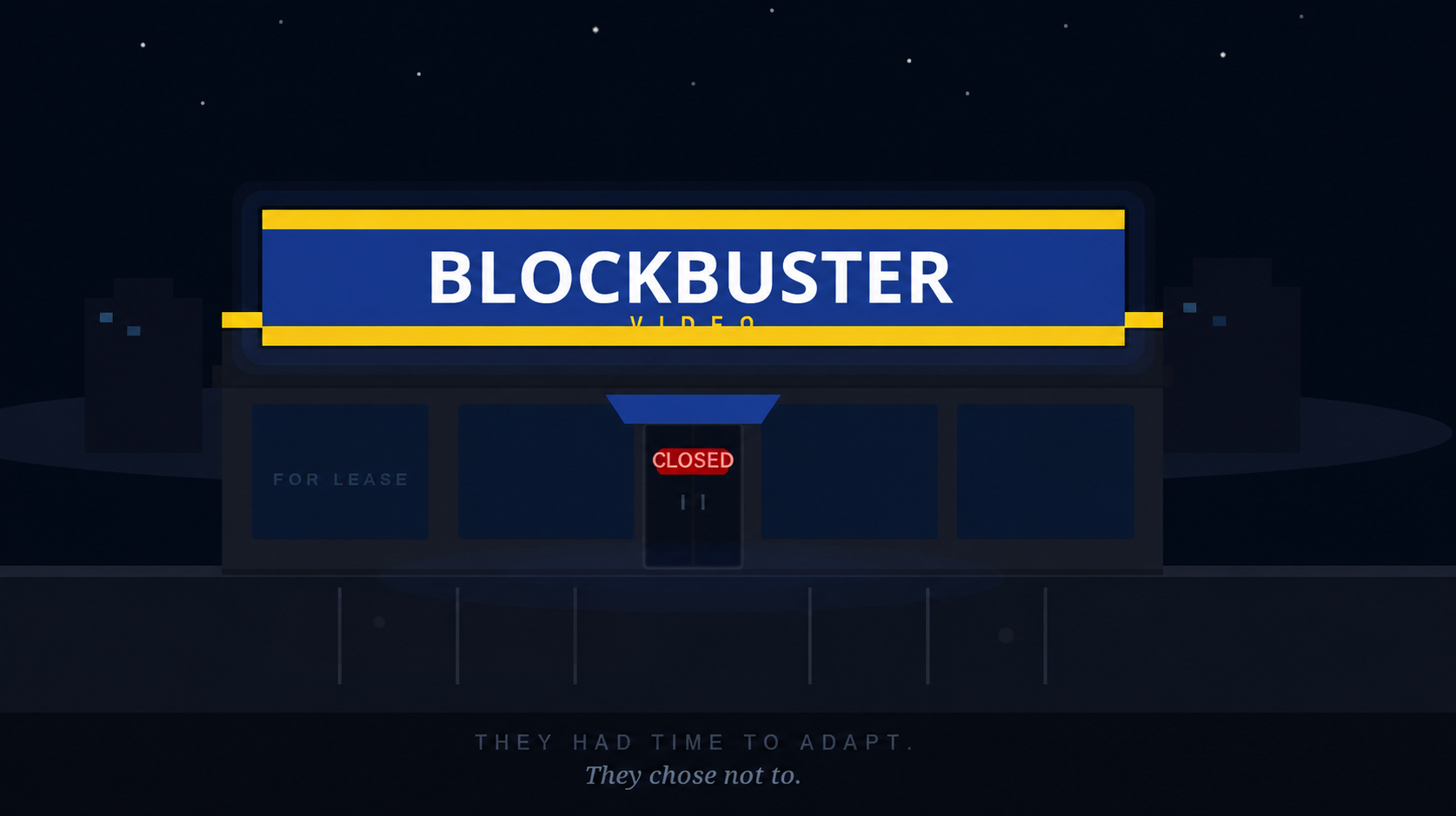
In 2000, Netflix approached Blockbuster with an offer to sell the company for $50 million.
Blockbuster passed.
Ten years later, Blockbuster filed for bankruptcy. Netflix was worth $13 billion.
Now, I’m not telling you this story because it’s a fun piece of business trivia. I’m telling you because the home service industry is sitting in the exact same position Blockbuster was in around 2003—comfortable, profitable, and almost completely unprepared for what’s already happening.
The disruption isn’t coming. It’s here. It’s just moving slow enough that most contractors aren’t panicking yet.
That’s actually the dangerous part.
What Blockbuster Got Wrong (And Why It Matters to You)
Blockbuster’s leadership team wasn’t stupid. They saw Netflix. They saw the early streaming experiments. They saw the writing on the wall.
They just didn’t believe it applied to them at the scale it actually did. They looked at their 9,000 stores, their millions of loyal customers, their established brand—and they decided the disruption was a niche threat, not an existential one.
That’s the cognitive trap. When you’re comfortable and profitable, threats look smaller than they are. You’ve got a full schedule, decent margins, and a phone that keeps ringing. Why would you restructure your entire operation around a threat that hasn’t fully materialized yet?
Because by the time it fully materializes, it’s too late to respond.
The home service industry is not immune to this. In fact, some of the disruption forces already at work are more structural and more accelerated than most contractors realize.
Let me walk you through what’s actually happening.
The Three Real Threats (Not the Ones You’re Worried About)
When contractors talk about disruption, they usually mention one thing: the app-based platforms. Handy, TaskRabbit, Amazon Home Services. The “Uber for home services” category.
And yes, those are real. But they’re not the biggest threat. Here are the three disruptions that concern me more.
1. Private Equity Rollups
This one is already in full swing.
PE firms have been acquiring HVAC, plumbing, and electrical companies at an accelerating pace. The math is simple: buy 10 small businesses at a 4-5x earnings multiple, combine them into one platform, and sell the whole thing at an 8-10x multiple. The arbitrage between small-business and mid-market valuations is enormous, and PE firms know it.
What does this mean for independent contractors?
It means you’re increasingly competing against companies that have access to capital you don’t, operational infrastructure you’d take years to build, and marketing budgets that dwarf yours. PE-backed platforms can afford to run unprofitable in your market for 18 months to gain share. Most independent operators can’t survive that.
It also means the talent market is shifting. These platforms are offering compensation packages, benefits, and career paths that independent contractors struggle to match. Your best technicians are being recruited right now.
This isn’t hypothetical. If you’re in a major metro market, there’s almost certainly a PE-backed platform operating within your service area today.
2. AI-Powered Customer Acquisition
Google, Amazon, and a handful of well-funded startups are actively building systems that change how homeowners find and hire service contractors.
The old model: homeowner searches, finds your website or your Google Business Profile, calls you.
The emerging model: homeowner asks an AI assistant, AI recommends a provider based on reviews, availability, price, and response time, homeowner books directly without ever visiting your website.
If that sounds like the future to you, you’re not paying attention. Amazon Alexa, Google Assistant, and several third-party platforms are already operating early versions of this model. The contractors who win in that environment are the ones with the data signals those AI systems trust—review velocity, response time, booking rate, repeat customer percentage.
The contractors who lose are the ones who never thought about any of that because they were too busy running calls.
3. The Labor Disruption Nobody Wants to Talk About
The skilled trades labor shortage is real and it’s getting worse before it gets better. The average age of a tradesperson in the United States is climbing. Trade school enrollment, while improving, has not kept pace with the retirement rate of experienced technicians.
This creates a compounding problem. As experienced techs retire, the knowledge and craftsmanship they carry goes with them. Replacing their output with less-experienced workers means more callbacks, lower customer satisfaction, and higher training costs. Meanwhile, PE-backed platforms are vacuuming up the best available talent with compensation packages most independents can’t match.
The labor disruption isn’t just about finding bodies. It’s about a structural shift in the availability of experienced, reliable talent—and the economics of replacing it.
Which Threats Are Real vs. Overblown
I want to be honest with you here, because the disruption conversation has a tendency to veer into either total dismissal (“this will never affect me”) or apocalyptic panic (“independent contractors are doomed”).
Neither is accurate.
Overblown threat: App-based gig platforms replacing skilled trade work. Handy and its competitors have found a niche in low-complexity, low-skill services—furniture assembly, basic handyman work, simple installs. They have not cracked skilled trade services at scale, and there are structural reasons why they probably won’t. Licensing requirements, liability exposure, and the genuine complexity of diagnostic and repair work create real barriers. These platforms are competitors at the margin, not existential threats for contractors doing real work.
Real threat: The data and review ecosystem. If you are not actively building your digital reputation—review velocity, Google Business Profile optimization, response time metrics—you are already losing ground in the new customer acquisition environment. This isn’t coming. It’s here. The contractors with 500 reviews and a 4.9 rating are winning the zero-click search result. The ones with 47 reviews and a 4.2 are invisible.
Real threat: PE-backed competition in major markets. If you’re in a top-50 metro, assume a PE-backed competitor is operating in your market or will be within 18 months. Your response strategy matters.
Overblown threat: AI replacing technicians. AI diagnostic tools are genuinely useful and improving. They are not replacing skilled technicians in any meaningful timeframe. The physical, diagnostic, and customer-relationship components of in-home service work are far more complex than AI-optimistic forecasts suggest. Use the tools. Don’t fear them.
Real threat: Talent retention. The combination of PE-backed compensation competition and demographic shifts in the trade labor market is a genuine long-term threat to independent operators who don’t invest in employer brand and career development.
The Moves That Build Defensible Advantages
Here’s the part I actually care about—not diagnosing the problem, but telling you what to do about it.
Independent contractors have structural advantages that PE-backed platforms genuinely cannot replicate. The key is knowing what those advantages are and intentionally amplifying them instead of trying to compete on resources you don’t have.
Build Depth in Your Customer Relationships
A PE-backed platform’s customer relationship is transactional by design. They’re optimizing for volume, not depth. Your advantage is that you can actually know your customers—their equipment history, their home, their preferences, their names.
This sounds obvious, but most contractors don’t operationalize it. Do you have a system that surfaces a customer’s full history before your tech walks in the door? Do your techs know to reference it? Does your follow-up communication feel personal or automated?
The contractors who build genuine customer relationships create retention that platforms can’t buy. A customer who has trusted you with their home for eight years and genuinely likes your team is not switching to an app because someone offered them $20 off.
Own Your Local Identity
PE-backed platforms are, almost by definition, faceless. They’re brands built in boardrooms, not communities. Your advantage is that you are local in a way they never will be.
Are you leveraging that? Are you visible in the community—sponsoring local events, showing up in local media, building relationships with the realtors and property managers and builders who refer work? Local identity is a genuine competitive moat that requires years to build and can’t be purchased overnight.
Build Your Review Velocity Now
I cannot emphasize this enough. The new customer acquisition environment rewards review velocity and recency, not just total count. A contractor with 50 reviews from the last 90 days outperforms a contractor with 500 reviews from the last five years in most local search environments.
Build a systematic review ask into every job. Not a text blast at the end of the month—a specific, personal ask at the moment of peak customer satisfaction, which is right after a successful job completion. Make it easy. Follow up once. Track your numbers weekly.
Develop Your Team as a Competitive Advantage
The labor market is tight and getting tighter. The contractors who win the talent competition aren’t just paying the most—they’re offering the clearest career path, the best training, and the strongest sense of belonging.
What does advancement look like at your company? Do your technicians know? Can they articulate it? If your answer is “we pay well and treat people right,” that’s not enough anymore. The platforms have benefits packages. You need to compete on culture, development, and opportunity.
Use the PE Playbook Against Them
Here’s something most independent contractors don’t realize: the systems and operational improvements PE firms make after acquiring a business are not secret. They’re well-documented, widely discussed, and almost entirely available to anyone who wants to implement them.
Job costing rigor. KPI dashboards. Dispatch efficiency metrics. Service agreement program structure. Technician performance incentives. These are not proprietary. They’re just uncommonly executed by independent operators.
The irony is that an independent contractor who runs their business with PE-level operational discipline—but with the customer relationships and community identity that PE can’t replicate—is a genuinely formidable competitor. Not despite being independent. Because of it.
A Honest Assessment of the Timeline
The disruption curve for home services is not a cliff—it’s a slope. And right now, most markets are somewhere in the early-to-middle portion of that slope.
That’s actually good news for prepared operators, because the slope gives you time. Not unlimited time. Not time to keep doing what you’ve always done and assume it will work forever. But time to build the advantages, develop the systems, and strengthen the customer relationships that make your business defensible against the forces that are coming.
The contractors who look back five years from now and say “we handled that well” are going to be the ones who started preparing before they felt the pressure. The ones who wait until PE competition, AI-driven acquisition, or labor dynamics make things uncomfortable are going to be scrambling to respond instead of positioning to win.
Blockbuster had time too. They just chose not to use it.
Frequently Asked Questions
Is private equity actually a threat in smaller markets? PE rollups have historically targeted major metro markets first, but the consolidation wave is moving into mid-size and smaller markets faster than most people expected. If you’re in a market with a population of 200,000 or more, it’s worth researching whether PE-backed operators have entered your area already. Assume they’re coming if they’re not there yet.
Should I be selling my business to PE before the market gets worse? That depends entirely on your goals and your business’s current performance. PE buyers are paying strong multiples for well-run businesses right now—but “well-run” is doing a lot of work in that sentence. Businesses with clean financials, documented systems, and strong customer retention command the best valuations. If your goal is an exit in the next three to five years, the time to prepare is now, regardless of whether you’re selling to PE or another buyer.
How do I compete on compensation when I can’t match PE-backed packages? You probably can’t match dollar-for-dollar on base compensation against a well-capitalized platform. You can compete on culture, flexibility, growth opportunity, and the things that large platforms structurally can’t offer—like genuine relationships, real voice in how the company operates, and a sense of ownership in something that matters. The contractors who retain their best people despite compensation competition are the ones who make their company a place people genuinely want to be.
What’s the first thing I should do if I haven’t addressed any of this? Audit your Google Business Profile and review ecosystem today. Not next week—today. Pull your total review count, your last 90 days of new reviews, and your average response time to new reviews. If any of those numbers make you uncomfortable, that’s your starting point. It’s also the highest-leverage, lowest-cost defensive move available to any contractor right now.
The Bottom Line
Blockbuster wasn’t destroyed by a better video store. It was destroyed by a fundamentally different model that its leadership team didn’t take seriously until it was too late.
The home service industry isn’t facing a better version of the same old competition. It’s facing structural shifts in how customers find contractors, how capital is competing in local markets, and how talent is being recruited and retained.
The independent contractors who come out of this stronger are the ones who see the disruption clearly, build the right advantages, and use the time they still have to make their businesses genuinely defensible.
That’s not pessimism. That’s the most actionable form of optimism available right now.
Want Help Building a Business That’s Ready for What’s Coming?
If you want to take an honest look at where your business is vulnerable—and build the systems, customer relationships, and team depth that protect you—let’s talk.
Book a strategy session and we’ll map out exactly where your operation needs to be stronger before the disruption hits harder in your market.